Tuesday, February 21, 2023

Why Do We Use Ashes on Ash Wednesday?


Why Do We Use Ashes on Ash Wednesday?


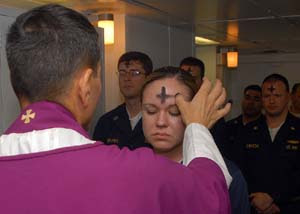
Ashes are placed on our foreheads on Ash Wednesday, in one of the most counter-cultural acts of our faith. It is done for two reasons: a personal act of remembrance and as a sign or a witness for others.


The ashes come from the burnt Palms from last year's Passion Sunday celebration, which begins Holy Week. So, these ashes bring us back to our last celebration of the Passion, Death and Resurrection of Jesus for us. On this first day of Lent, we begin a journey of renewal - from death to life. This is a joyful season. We will make sacrifices, in order to try to let God reform our desire, but this is a time for God to be generous to us.


When the ashes are placed on our foreheads, the minister says one of two formulas to help us remember who we are and the mission to which we are sent:


"Remember, man/woman, you are dust and to dust you will return."


"Turn away from sin and be faithful to the Gospel."


We are reminded that we are creatures and that our lives were given to us. But, we are also reminded that our lasting home is in eternity, with God. This is not our lasting home.


We are reminded that our call is to turn away from sin and to believe the Good News of our salvation in Jesus. This is a joyful reminder. It challenges us, for sure, but reminds us of why we want to turn from sin.


Finally, we wear our ashes as a sign. It is not a boastful sign through which I say, "Look at me and see how holy I am." No, it is much more like, "I'm willing to wear this sign in the world and say that I've been reminded of where I come from and where I am going. And, I've heard the call to turn away from a life of sin and to give my life to living the Gospel of Jesus." And, occasionally, in this world which is too often caught up in the denial of death, I might be required to answer the question, "What's with the smudge on your forehead?"


Yet even now, says the LORD, return to me with your whole heart, with fasting, and weeping, and mourning; Rend your hearts, not your garments, and return to the LORD, your God. For gracious and merciful is he, slow to anger, rich in kindness, and relenting in punishment. - Joel 2:12-13


A Brief on Ash Wednesday

Remember that you are dust, and to dust, you shall return. 


It was a common practice within the early Church that those who were found guilty of grave public sin needed to do public penance before they were admitted back into communion with the Church and admitted to the Most Holy Eucharist. The public sinners came forward in sackcloth forty days before Easter and were sprinkled with ashes, in keeping with many Old Testament examples of public penance. They fasted and prayed for forty days and then, on Easter, were readmitted into full communion with the Church. Eventually, prior to the end of the first millennium, this practice was extended to the entire Church as a way of highlighting everyone’s need for penance. One of the earliest mentions of this practice becoming universal comes from an English Benedictine monk who wrote: 


We read in the books both in the Old Law and in the New that the men who repented of their sins bestrewed themselves with ashes and clothed their bodies with sackcloth. Now let us do this little at the beginning of our Lent that we strew ashes upon our heads to signify that we ought to repent of our sins during the Lenten fast.


Today, as a sign of our ongoing need to repent of our sins and do penance, the faithful are invited to come forward to be marked with ashes as a sign of their commitment to the penitential season of Lent, so as to celebrate with great joy the Solemnity of Easter. Lent is forty-six days long. Forty of those days are penitential days, and six of them are Sundays. Lent begins on Ash Wednesday and concludes with the Easter Vigil. The forty penitential days are an imitation of Jesus’ forty days in the desert.


As we come forward to receive ashes, the minister traditionally says, “Remember that you are dust, and to dust you shall return.” This line is taken from the Book of Genesis when God expelled Adam and Eve from the Garden of Eden. He told Eve that she would suffer the pains of childbirth and be subjected to her husband. God told Adam that he would labor for his food through sweat and toil. To both of them, God said this curse would last “Until you return to the ground, from which you were taken; For you are dust, and to dust you shall return” (Genesis 3:19). Thus, the final curse of original sin is death: “…to dust you shall return.”


As we come forward to receive ashes, we should hear God saying to us, as He said to Adam and Eve, that we also suffer the consequences of original sin and will die. But that curse must be seen in the light of God’s final plan of salvation. Today, we acknowledge that the curse of death will endure but also hold onto the hope of resurrection made possible through Christ. Lent is a time of repentance for our sin and hope in redemption. Ash Wednesday is our liturgical and public statement that we have chosen both repentance and redemption.


As you come forward to receive the ashes today, don’t just go through the motions. Make this act a prayer and one of deep interior devotion. Call to mind your sins and the sins of your whole life, as best you can. Acknowledge the just punishment of eternal death that you deserve for your sins. But then call to mind the infinite and unmerited mercy of God. Remember that even though you are an undeserving sinner, God has reached down from Heaven to offer you the gift of eternal salvation. He has invited you to receive this gift through your repentance and humility. Humble yourself today in “sackcloth and ashes,” and as with those public sinners of old, God will use this Lent to more fully unite your soul with His through His glorious death and resurrection.


Prayer:

Most glorious and Triune God, You have justly condemned me but mercifully offered me redemption. As I enter this season of Lent, I wholeheartedly acknowledge my sin and repent. Please be merciful to me, a sinner. Help me to make this Lent a truly penitential season so that my soul will be more disposed to receive You this Easter. Jesus, I trust in You.


Monday, January 16, 2023

Do Catholics Worship Statues?


Do Catholics Worship Statues?

“Catholics worship statues!” People still make this ridiculous claim. Because Catholics have statues in their churches, goes the accusation, they are violating God’s commandment: “You shall not make for yourself a graven image or any likeness of anything that is in heaven above, or that is in the earth beneath, or that is in the water under the earth: you shall not bow down to them or serve them” (Ex. 20:4–5).

It is right to warn people against the sin of idolatry when they are committing it. But calling Catholics idolaters because they have images of Christ and the saints is based on misunderstanding or ignorance of what the Bible says about the purpose and uses (both good and bad) of statues.

Anti-Catholic writer Loraine Boettner, in his book Roman Catholicism, makes the blanket statement, “God has forbidden the use of images in worship” (281). Yet if people were to “search the scriptures” (John 5:39), they would find the opposite is true. God forbade the worship of statues, but he did not forbid the religious use of statues. Instead, he actually commanded their use in religious contexts!

God Said to Make Them
People who oppose religious statuary forget about the many passages where the Lord commands the making of statues. For example: “And you shall make two cherubim of gold [i.e., two gold statues of angels]; of hammered work shall you make them, on the two ends of the mercy seat. Make one cherub on the one end, and one cherub on the other end; of one piece of the mercy seat shall you make the cherubim on its two ends. The cherubim shall spread out their wings above, overshadowing the mercy seat with their wings, their faces one to another; toward the mercy seat shall the faces of the cherubim be” (Ex. 25:18–20).

David gave Solomon the plan “for the altar of incense made of refined gold, and its weight; also his plan for the golden chariot of the cherubim that spread their wings and covered the ark of the covenant of the Lord. All this he made clear by the writing of the hand of the Lord concerning it all” (1 Chr. 28:18–19). David’s plan for the temple included statues of angels.

Similarly Ezekiel 41:17–18 describes graven (carved) images in the idealized temple he was shown in a vision, for he writes, “On the walls round about in the inner room and [on] the nave were carved likenesses of cherubim.”

The Religious Uses of Images
During a plague of serpents sent to punish the Israelites during the exodus, God told Moses to “make [a statue of] a fiery serpent, and set it on a pole; and every one who is bitten, when he sees it shall live. So Moses made a bronze serpent, and set it on a pole; and if a serpent bit any man, he would look at the bronze serpent and live” (Num. 21:8–9).

One had to look at the bronze statue of the serpent to be healed, which shows that statues could be used ritually, not merely as religious decorations.

Catholics use statues, paintings, and other artistic devices to recall the person or thing depicted. Just as it helps to remember one’s mother by looking at her photograph, so it helps to recall the example of the saints by looking at pictures of them. Catholics also use statues as teaching tools. In the early Church they were especially useful for the instruction of the illiterate. Many Protestants have pictures of Jesus and other Bible pictures in Sunday school for teaching children. Catholics also use statues to commemorate certain people and events, much as Protestant churches have three-dimensional nativity scenes at Christmas.

If one measured Protestants by the same rule, then by using these “graven” images, they would be practicing the “idolatry” of which they accuse Catholics. But there’s no idolatry going on in these situations. God forbids the worship of images as gods, but he doesn’t ban the making of images.

It is when people begin to adore a statue as a god that the Lord becomes angry. Thus, when people did start to worship the bronze serpent as a snake-god (whom they named “Nehushtan”), the righteous king Hezekiah had it destroyed (2 Kgs. 18:4).

What About Bowing?
Sometimes anti-Catholics cite Deuteronomy 5:9, where God said concerning idols, “You shall not bow down to them.” Since many Catholics sometimes bow or kneel in front of statues of Jesus and the saints, anti-Catholics confuse the legitimate veneration of a sacred image with the sin of idolatry.

Though bowing can be used as a posture in worship, not all bowing is worship. In Japan, people show respect by bowing in greeting (the equivalent of the Western handshake). Similarly, a person can kneel before a king without worshipping him as a god. In the same way, a Catholic who may kneel in front of a statue while praying isn’t worshipping the statue or even praying to it, any more than the Protestant who kneels with a Bible in his hands when praying is worshipping the Bible or praying to it.

Hiding the Second Commandment?
Another charge sometimes made by Protestants is that the Catholic Church “hides” the second commandment. This is because in Catholic catechisms, the first commandment is often listed as “You shall have no other gods before me” (Ex. 20:3), and the second is listed as “You shall not take the name of the Lord in vain.” (Ex. 20:7). From this, it is argued that Catholics have deleted the prohibition of idolatry to justify their use of religious statues. But this is false. Catholics simply group the commandments differently from most Protestants.

In Exodus 20:2–17, which gives the Ten Commandments, there are actually fourteen imperative statements. To arrive at Ten Commandments, some statements have to be grouped together, and there is more than one way of doing this. Since, in the ancient world, polytheism and idolatry were always united—idolatry being the outward expression of polytheism—the historic Jewish numbering of the Ten Commandments has always grouped together the imperatives “You shall have no other gods before me” (Ex. 20:3) and “You shall not make for yourself a graven image” (Ex. 20:4). The historic Catholic numbering follows the Jewish numbering on this point, as does the historic Lutheran numbering.

Jews and Christians abbreviate the commandments so that they can be remembered using a summary, ten-point formula. For example, Jews, Catholics, and Protestants typically summarize the Sabbath commandment as, “Remember the Sabbath to keep it holy,” though the commandment’s actual text takes four verses (Ex. 20:8–11).

When the prohibition of polytheism/idolatry is summarized, Jews, Catholics, and Lutherans abbreviate it as “You shall have no other gods before me.” This is no attempt to “hide” the idolatry prohibition (Jews and Lutherans don’t even use statues of saints and angels). It is to make learning the Ten Commandments easier.

The Catholic Church is not dogmatic about how the Ten Commandments are to be numbered, however. The Catechism of the Catholic Church says, “The division and numbering of the Commandments have varied in the course of history. The present catechism follows the division of the Commandments established by Augustine, which has become traditional in the Catholic Church. It is also that of the Lutheran confession. The Greek Fathers worked out a slightly different division, which is found in the Orthodox Churches and Reformed communities” (CCC 2066).

The Form of God?
Some anti-Catholics appeal to Deuteronomy 4:15–18 in their attack on religious statues: “[S]ince you saw no form on the day that the Lord spoke to you at Horeb out of the midst of the fire, beware lest you act corruptly by making a graven image for yourselves, in the form of any figure, the likeness of male or female, the likeness of any beast that is on the earth, the likeness of any winged bird that flies in the air, the likeness of anything that creeps on the ground, the likeness of any fish that is in the water under the earth.”

We’ve already shown that God doesn’t prohibit the making of statues or images of various creatures for religious purposes (cf. 1 Kgs. 6:29–32, 8:6–66; 2 Chr. 3:7–14). But what about statues or images that represent God? Many Protestants would say that’s wrong because Deuteronomy 4 says the Israelites did not see God under any form when he made the covenant with them; therefore we should not make symbolic representations of God either. But does Deuteronomy 4 forbid such representations?

The Answer Is No
Early in its history, Israel was forbidden to make any depictions of God because he had not revealed himself in a visible form. Given the pagan culture surrounding them, the Israelites might have been tempted to worship God in the form of an animal or some natural object (e.g., a bull or the sun).

But later God did reveal himself under visible forms, such as in Daniel 7:9: “As I looked, thrones were placed and one that was Ancient of Days took his seat; his raiment was white as snow, and the hair of his head like pure wool; his throne was fiery flames, its wheels were burning fire.” Protestants make depictions of the Father under this form when they do illustrations of Old Testament prophecies.

The Holy Spirit revealed himself under at least two visible forms—that of a dove, at the baptism of Jesus (Matt. 3:16; Mark 1:10; Luke 3:22; John 1:32), and as tongues of fire, on the day of Pentecost (Acts 2:1–4). Protestants use these images when drawing or painting these biblical episodes and when they wear Holy Spirit lapel pins or place dove emblems on their cars.

But more important, in the incarnation of Christ his Son, God showed mankind an icon of himself. Paul said, “He is the image (Greek: ikon) of the invisible God, the firstborn of all creation.” Christ is the tangible, divine “icon” of the unseen, infinite God.

We read that when the magi were “going into the house they saw the child with Mary his mother, and they fell down and worshipped him. Then, opening their treasures, they offered him gifts, gold, frankincense, and myrrh” (Matt. 2:11). Though God did not reveal a form for himself on Mount Horeb, he did reveal one in the house in Bethlehem.

Common sense tells us that, since God has revealed himself in various images, most especially in the incarnate Jesus Christ, it’s not wrong for us to use images of these forms to deepen our knowledge and love of God. That’s why God revealed himself in these visible forms, and that’s why statues and pictures are made of them.

Idolatry Condemned by the Church
Since the days of the apostles, the Catholic Church has consistently condemned the sin of idolatry. The Catechism of the Council of Trent (1566) taught that idolatry is committed “by worshipping idols and images as God, or believing that they possess any divinity or virtue entitling them to our worship, by praying to, or reposing confidence in them” (374).

What anti-Catholics fail to recognize is the distinction between thinking a piece of stone or plaster is a god and desiring to visually remember Christ and the saints in heaven by making statues in their honor. The making and use of religious statues is a thoroughly biblical practice. Anyone who says otherwise doesn’t know his Bible.

---------------------------------------------------------------------------------------------------------------
NIHIL OBSTAT: I have concluded that the materials presented in this work are free of doctrinal or moral errors.
Bernadeane Carr, STL, Censor Librorum, August 10, 2004

IMPRIMATUR: In accord with 1983 CIC 827 permission to publish this work is hereby granted.
+Robert H. Brom, Bishop of San Diego, August 10, 2004


Friday, September 30, 2022

St. Thérèse of Lisieux - (St. Thérèse of The Child Jesus)


St. Thérèse of Lisieux


St. Thérèse of Lisieux, Religious

1873 – 1897

October 1 – Memorial

Liturgical Color: White

Patron Saint of florists, missions & aviators


A sensitive country girl confines herself to a convent and writes about spiritual truths


Thérèse Martin was a weepy child, as emotionally brittle as porcelain. She was easily offended and easily pleased. A furled brow or a sideways glance from her father would dissolve her into tears. A beautiful flower or a kind word and she would beam a smile. She grew up in a brotherless home. Her father, an uncle, and priests were the men in her life. Her parents were canonized in 2015, the only married couple ever raised to the altars. Thérèse and her four sisters all became nuns, with the cause for beatification and canonization of her sister Léonie being opened in 2015. The Martin home was totally absorbed in the mysteries of God, prayer, saints, the Sacraments, and the Church. 


Thérèse grew up in Normandy, a region of Northern France. She left only once, to go on a month-long pilgrimage to Italy, where she met Pope Leo XIII at a public audience and begged his special permission to enter the Carmelites before the required age. On this trip she was also the object of some tender male glances. Conscious of her delicate emotions and eager to flee the world’s “poisonous breath,” upon returning from Italy Thérèse pulled every lever to enter her local Carmel. She finally entered at the age of fifteen in 1888. She was given the religious name “of the Child Jesus” and received permission to adopt a second name too, “of the Holy Face.” Once the door of the convent shut behind her, it never reopened. Her short life ended there just nine years later. Thérèse was a dedicated nun who strictly followed the demanding Carmelite rule. She kept silence when required, avoided seeking out her blood sisters, fasted, ingratiated herself with nuns she did not naturally find sympathetic, and spent long hours in prayer and work. 


In the convent, Thérèse’s childish sweetness matured into a more durable spirituality. Her sensitivity mellowed. She was able to accept criticism. Her youthful presumption that all priests were as perfect as diamonds became more realistic, and she prayed and sacrificed ardently for priests. The hard realities of convent life narrowed Thérèse’s spiritual goals. She no longer desired to be a great soul like Saint Joan of Arc. But with this narrowing came a deepening, a concentrated focus. She decided she would be God’s heart, not His hands or feet or mind. She decided that the only way she could fly close to the blazing sun of the Holy Trinity would be to become small. Her petite voie (“little way” or “by small means”) was to spiritually reduce herself to a tiny creature carried in the claws of the divine eagle, Jesus Christ. As Christ soared in the heavens, she would be in His grasp, going only where He could go, until she was burned up in the Father-Son-Spirit love of the fireball of the Trinity. This was no broad path or wide way, but a little way for a great soul. The goal was to reduce oneself to nothing so the Lord could transport you. The goal was to remove the “self” from “oneself.” 


When Thérèse’s sister Céline entered the convent in 1894, she was given permission to bring her camera. Céline’s pictures of Thérèse would be among the first ever taken of a saint. They complimented Thérèse’s letters and spiritual writings perfectly, heightening interest in Thérèse after she died. The intriguing photos and profound writings hinted at the secret depths concealed behind a convent’s four walls. Saint Thérèse suffered intensely from tuberculosis and died at an age when many lives are just beginning to flower. She was canonized in 1925, declared co-patron of France in 1944, and named the thirty-third Doctor of the Church by Pope Saint John Paul II in 1997, the youngest Doctor to date and probably the youngest the Church will ever recognize.


Saint Thérèse of the Child Jesus and of the Holy Face, you discovered deep truths in a confined space. Your soul was fertile ground for the mysteries of our faith. Lend heavenly assistance to all who try to emulate your example of suffering, prayer, and tender dedication to God.


Monday, August 8, 2022

Catholics and Christians

Q. Since I started college this fall, I’ve been making a lot of friends who aren’t Catholic. Some of them are Christian, but some of them don’t even go to church. When we talk, I’m not really sure how to tell them what’s the big deal about being Catholic. What should I say?

A. I’d say you have a great opportunity to make a difference in their lives! Our Catholic faith is something that is an incredible gift. Therefore, to understand it, live it and spread it is an incredible privilege. So when your new friends ask about your faith I’d say you have a great opportunity to give them something they will greatly benefit from.

Sharing the Catholic faith with your friends is something that, perhaps, can only be done by you. Maybe at some later time in their lives they will encounter another good Catholic who will share his/her faith with them but, then again, maybe not. So I’d encourage you to look at this opportunity as possibly their “once in a lifetime” opportunity to learn about the incredible gift of the Catholic faith.

As Catholics we believe that we are privileged to have the fullness of the faith. What does this mean? It especially means two things. First, it means that we are blessed to have the fullest understanding of what Jesus wants us to understand and believe. As Catholics we trace our faith roots all the way back to Jesus Himself. All Popes are successors to St. Peter and, thus, shares in the divine mandate to hold the keys to the Kingdom of Heaven! That means they continue to guide us into all truth and teach us with the authority of Jesus Himself. This understanding is one that everyone needs to understand.

Furthermore, we, as Catholics, are blessed beyond what we can ever imagine by being able to share in the sacramental life of the Church. Though sometimes the Sacraments may seem dry, dull and repetitious to some, to those who understand the Sacraments they are the greatest way of connecting to God and receiving His grace.

These facts about the Catholic faith may be hard to explain but let me offer a suggestion on how to do just that.

First, I suggest that you keep striving to understand and live your own Catholic faith to the fullest. Study the faith, celebrate the Sacraments with great devotion, and try to discover the great gift that this faith gives you.

Second, when you are living fully as a Catholic, the best way to share that faith is to speak to your friends on a personal level. In other words, if you regularly live the Catholic faith then, when the opportunity presents itself, you can easily tell your friends how much this faith means to you. You can share how God comes to meet you as you attend Mass and Reconciliation. You can explain your deep confidence in Jesus’ teaching as it comes to you from the pope and bishops. And you can simply share your deep love for God as you meet Him daily in the Catholic Church.

Sharing this with your friends may have the effect of igniting within them a desire to gain what you have. When they see your joy, your faith and you devotion they may simply want to jump on board and discover what the Catholic Church is all about.

The bottom line is that if you truly love being a Catholic and live it to the fullest you will automatically draw others to what you have discovered. God will guide you in this if you are open to let Him use you. And remember, you may be the only opportunity that these new friends have to discover God within our glorious Catholic Church!

(Taken from Catholic Q & A)

Click on the title below for answers to previous five queries


Friday, July 8, 2022

Is it wrong of me to pray for the vocation of marriage?


Q. I know you’ve talked about vocations for people who are interested in being a priest or a sister, but is it wrong of me to pray for the vocation of marriage? The way some of my friends talk, I think they all plan to live with someone and then decide whether they want to get married.


A. I think praying for the vocation to marriage is a wonderful idea! And very much needed today! Let me offer a few thoughts on this.


Praying for your vocation is very important. But, in all truth, there may even be something necessary for many people even before they pray for their vocation. Namely, they need to realize they actually have a vocation. Perhaps to some this seems like an obvious statement but I’m guessing that more people than you realize do not even understand the ideal of a vocation as they grow and begin to look at their future. Many just presume they will fall in love one day and get married and all will be well. And though this may be the case for many, there is still a step or two missing.


I think the first thing that all young people need to realize is that God has a plan for your life. So, I suggest to all teens and college aged students that you begin by the realization that God has a perfect plan for your life and the key is to discern this. A good prayer to pray every day is something like, “Lord, I say yes to your will in my life. I may not know it yet but whatever it is I desire to follow that plan alone. Give me the insight to discern that plan and the courage to say yes to it every day.”


From there, when someone truly discerns a calling from God to marriage, the process has just begun. It’s not so much about simply going out and “falling in love.” Rather, it’s about letting the Holy Spirit guide you to the person you are called to marry. When you meet someone I’d suggest you spend a lot of time in prayer asking the Lord for guidance in your relationship. Keep the relationship pure and Christ centered. Challenge the person to treat you as a child of God and with love and respect. And, of course, strive to do the same yourself. If Christ is at the center of that relationship and if you are continually seeking God’s will then little by little the Holy Spirit will confirm in your heart that this marriage is your vocation and that this particular person is called to be your spouse.


I realize that many people may not follow this process of discernment so it’s also very important to note that once a couple enters into marriage, and especially marriage as a sacrament within our Church, God’s grace will be there calling you to now live the vows you made. Prayer to live those vows well is so essential these days. Many marriages are wonderful and fulfilling. But way too many bring great pain and hardship. Continually saying yes to your vows, being faithful to them, deepening your unwavering commitment and striving to give yourself to your spouse in the same way that Christ gave Himself to the Church is the key. And this requires much prayer. So prayer before and during marriage is essential.


And to your last point about living together. This is a popular idea today. However, I can assure you that it is always a bad idea. It will always weaken the foundation of your vows and married life. Living together is not a “test marriage” since there is no permanent marriage covenant there yet. In fact, I’m confident in telling you that living together before marriage greatly increases your chances of divorce and an unhappy marriage down the road. The statistics support this statement too. So approach dating, engagement and marriage the way God’s grace leads you and you will not regret it!


(Taken from Catholic Q & A)

Click on the title below for answers to previous five queries


Thursday, June 30, 2022

Frequency of Confession

Q. I go to confession at least once a month. Most of my friends don’t go as often, and some don’t seem to go at all. A couple of my friends tell me I’m being OCD about it and I should get some help. I’m not sure how to tell them that they’re the ones who need the help.

A. Generally speaking, I think going to confession once a month is a great idea! It’s a very good way to stay close to God and keep His grace alive in your life! The Sacrament of Reconciliation is a wonderful gift from God because it’s His way of cleansing us of our sin and weakness. In His great love for us we are immersed in His Divine Mercy every time we celebrate that sacrament. So keep it up and don’t let your friends tell you differently.


As for trying to tell them that “they’re the ones who need the help,” let me suggest you do it in a very subtle and positive way. The best way to tell them this is by your good example. Share with them the blessings you see in your life by using this sacrament on a regular basis. Let your faith in God’s grace shine forth for them to see. Often, when our friends see good things happening in our lives, they will want to imitate what we are doing. So the more you can share the good fruits in your life with them, the better.


Since you mention OCD (Obsessive Compulsive Disorder), let me also offer a comment on this struggle that some people deal with. I offer it as a general comment that some need to hear rather than presuming that this is your struggle. But it’s worth mentioning since some people do struggle with this.


OCD is a very heavy cross. In the spiritual life it comes out in the form of scrupulosity. In this case the person becomes so focused on his/her sin that it seems everything is a mortal sin, and they can feel a need to go to confession all the time. In fact, some can feel as though they need to remember every last sin and offer every detail of their sins. And then after confession, they may worry that they did not confess everything and feel a need to return to the confessional right away. This is a real burden.


What I have found to be helpful in this situation is for the person struggling with this to go to confession to the same priest each time rather than several different priests. This way the one priest, who is aware of the tendency to scrupulosity, can help that person to stay balanced in their confession. Over time they can start to be freed of their scrupulosity and begin experiencing the freedom that God wants for them. Our God is a God of abundant mercy, and He wants us to know and experience that mercy.


Hope that helps clarify things. Keep up the good effort of practicing this wonderful sacrament!


(Taken from Catholic Q & A)


Friday, June 24, 2022

The Tough Topic of Pornography


Q. I have some friends who like to look at pornography on the Internet. My parents have always said that kind of stuff degrades women. When they start looking at the pictures, I just don’t look, but I haven’t ever said anything. I don’t really want to lose them as friends, and I don’t want people to think I’m weird. What can I do?


A. My dear friend…this is, unfortunately, a topic that affects more people than most of us want to admit. Let me offer a few thoughts.


First of all I think your parents response is absolutely correct! And I’d add that it also degrades men. This is a good conviction to keep in the forefront of your mind any time this discussion or temptation comes up.


Why is it degrading? As one very good chastity speaker I heard recently said, “The problem with pornography is not that it shows too much, rather, it shows too little!” I think this is a very good statement. What I believe he means is that pornography only shows the body of another and does so in a way that the person is turned into a selfish object of another’s disordered pleasure. We call this “objectification.” Therefore, it “shows too little” in the sense that pornography fails to show the true beauty and dignity of the person being exposed. It fails to reveal that this person is in fact a person…a son or daughter of God made in God’s image and likeness. It also does much damage to the person looking at the images, because it has the effect of drawing that person into a disordered sexual desire. This means that the person’s sexual desires will most likely become disordered and out of control by the use of pornography. This creates a sort of “imprisonment” and unhealthy attachment. As a result, the person caught in the world of pornography will have a hard time looking at others with dignity, respect and true love. It truly has the potential to affect one’s relationships in a very negative and selfish way. So, yes, it is degrading all the way around.


Regarding your friends who are looking at pornography and trying to expose you to it, you say that you “don’t really want to lose them as friends” and that you “don’t want people to think [you are] weird.” I have a couple of thoughts on this. First, it’s not “weird” in any sense of the word to respect the dignity of another person and to see them the way God sees them. God would never want you to look at another person the way they are portrayed in pornographic images. So, believe me, you are far from weird for not wanting to get drawn into this practice.


And as for losing them as friends, I think it’s important to understand what a friend is and is not. A true friend would not push you into this practice. A true friend would see that this is unhealthy and would respect this desire in you. So, if they do not want to spend time with you or make fun of you or even call you “weird” for not being interested in this, then I can assure you these are not your friends. I know the pressure can be strong to, in a sense, “fit in” with the crowd. But it’s not worth it. You are much better off standing your ground and experiencing their rejection than you are going with the flow of this disordered behavior. Recent brain science studies reveal that pornography can be as addicting as some of the most addicting drugs, and there are many who are so addicted that they simply cannot find a way to break their habits. This addiction, for many, can go on for years and cause much distress, guilt, shame and sexual confusion. And the end result is that an addiction to pornography can (and I dare say “will”) affect your healthy ability to love others in the way God wants you to.


So, stay strong and keep talking to your parents about this. That open communication with them will help you for years to come!


(Taken from Catholic Q & A)


About Queen of the Holy Rosary

🌹 Queen of the Holy Rosary  Our Mother in Battle and in Blessing From the seas of Lepanto to the struggles of our hearts — the Rosary rema...