Showing posts with label Article. Show all posts

Tuesday, October 7, 2025

About Queen of the Holy Rosary


🌹 Queen of the Holy Rosary 
Our Mother in Battle and in Blessing

From the seas of Lepanto to the struggles of our hearts — the Rosary remains our greatest weapon of faith.


Every October, the Church celebrates a feast that reminds us that prayer can change the course of history. It’s the Feast of Our Lady of the Rosary, a title born out of courage, faith, and the loving intercession of the Blessed Virgin Mary.


⚔️ A Battle Between Two Powers

The year was 1571. The mighty Ottoman Empire, undefeated for nearly a century, threatened to sweep through Christian Europe. Pope St. Pius V, a man of deep prayer, knew this was no ordinary conflict — it was a spiritual battle.

He called on all Christians to pray the Rosary, entrusting the fate of Europe to the Blessed Mother.

On the night before the decisive Battle of Lepanto, sailors of the Holy League — a coalition of Catholic nations — knelt on their decks and prayed the Rosary with profound faith.

At dawn on October 7, 1571, the Christian fleet faced the Ottoman navy in the Gulf of Patras, Greece. The enemy ships formed a crescent — the symbol of Islam — while the Christian ships took the shape of a Cross.

After five fierce hours, the Christian fleet won a miraculous victory. That same day in Rome, Pope Pius V had a vision of the Blessed Virgin Mary, who revealed that victory had been granted through her intercession.

He declared October 7 the Feast of Our Lady of Victory, later renamed the Feast of Our Lady of the Rosary.

This victory was more than a triumph at sea — it was a triumph of faith over fear, prayer over power, and heaven over earth.


🙏 The Power of the Rosary

The Rosary is not just a string of beads — it is a chain of grace that binds us to heaven. Each “Hail Mary” is a loving call to our Mother, each decade a step through the mysteries of Christ’s life.

Through the Rosary, we meditate on the Joyful, Sorrowful, Glorious, and Luminous Mysteries — the sacred moments that tell the story of our salvation.

When we pray the Rosary, Mary gently takes our hand and leads us closer to Jesus. It’s a prayer that brings peace to the restless heart, hope to the weary soul, and light to those walking in darkness.


👑 Mary, Queen of the Holy Rosary

Mary is the Queen of the Rosary because she is the Queen Mother — and her Son, Jesus Christ, is our King. The Rosary, given to St. Dominic in the 13th century, became her gift to the world — a weapon against sin, despair, and evil.

Every time we pray it, heaven listens, and Mary intercedes.


✨ The Fifteen Promises of the Holy Rosary

Our Lady made fifteen loving promises to those who faithfully pray the Rosary. Given to St. Dominic and Blessed Alan de la Roche, they remind us that devotion to the Rosary brings great blessings in life and eternity:

  1. Those who faithfully serve me by the recitation of the Rosary shall receive signal graces.

  2. I promise my special protection and the greatest graces to all those who shall recite the Rosary.

  3. The Rosary shall be a powerful armor against Hell; it will destroy vice, decrease sin, and defeat heresies.

  4. It will cause virtue and good works to flourish; it will obtain for souls the abundant mercy of God.

  5. The soul which recommends itself to me by the recitation of the Rosary shall not perish.

  6. Those who recite my Rosary devoutly shall never be conquered by misfortune. Sinners shall convert; the just shall persevere in grace.

  7. Those who have a true devotion to the Rosary shall not die without the Sacraments of the Church.

  8. Those who faithfully recite the Rosary shall have, during their life and at their death, the light of God’s grace and the fullness of His blessings.

  9. I shall deliver from Purgatory those who have been devoted to the Rosary.

  10. The faithful children of the Rosary shall merit a high degree of glory in Heaven.

  11. You shall obtain all that you ask of me by the recitation of the Rosary.

  12. Those who propagate the Rosary shall be aided by me in their necessities.

  13. I have obtained from my Divine Son that all the advocates of the Rosary shall have for intercessors the entire celestial court.

  14. All who recite the Rosary are my beloved children and the brothers and sisters of my only Son, Jesus Christ.

  15. Devotion to my Rosary is a great sign of predestination.

Each promise is a reflection of Mary’s tender care — a reminder that she never forgets her children who turn to her in faith.


💫 The Rosary Still Wins Battles

The Battle of Lepanto may have been fought centuries ago, but our world still faces storms — fear, division, moral confusion, and loss of faith. The Rosary remains a mighty anchor in turbulent times.

When we take the beads into our hands, we are not alone. We join millions of voices across the world, past and present, whispering the same timeless prayer:
“Hail Mary, full of grace…”

Through every decade, peace is born again — in our hearts, in our homes, and in our world.


🌸 A Closing Prayer to Our Lady of the Rosary

O Blessed Mother, Our Lady of the Rosary,
You stood by your Son in His triumph and in His suffering.
Teach us to pray as you prayed — with trust, with love, and with courage.

Intercede for us in our battles, both seen and unseen.
Protect our families, strengthen our faith, and bring peace to our world.

As we hold your Rosary, may we always remember the victory won through prayer,
and may our hearts echo your own words:
“My soul magnifies the Lord.”

Amen.


“Give me an army saying the Rosary,” said Blessed Pius IX, “and I will conquer the world.”

Let us take up our beads this October — not as a routine, but as a revolution of faith.
Because when the Rosary is prayed with love, heaven listens, and miracles happen.

Thursday, April 6, 2023

INDULGENCES ATTACHED TO DIVINE MERCY DEVOTIONS

 INDULGENCES ATTACHED TO DIVINE MERCY DEVOTIONS

Apostolic Penitentiary


On 29 June, 2002, the Apostolic Penitentiary published the Decree in which the Holy Father attached a plenary and a partial indulgence to the devout observance of the Second Sunday of Easter or Divine Mercy Sunday. In an audience given to the Pro-Penitentiary Major and the Regent of the Apostolic Penitentiary on 13 June, 2002 the Holy Father approved the content of the Decree. The Decree was published in the press on 3 August 2002 and announced by the Holy Father at the Sunday Angelus on 4 August 2002.


DECREE


Indulgences attached to devotions in honour of Divine Mercy


"O God, your mercy knows no bounds and the treasure of your goodness is infinite..." (Prayer after the "Te Deum" Hymn) and "O God, you reveal your almighty power above all by showing mercy and forgiveness..." (Prayer for the 26th Sunday ofOrdinary Time), in these prayers Holy Mother Church humbly and faithfully sings of Divine Mercy. Indeed, God's great patience with the human race in general and with each individual person shines out in a special way when sins and moral failures are forgiven by Almighty God Himself and the guilty are readmitted in a fatherlike way to his friendship, which they deservedly lost.


Duty of honouring Divine Mercy


The faithful with deep spiritual affection are drawn to commemorate the mysteries of divine pardon and to celebrate them devoutly. They clearly understand the supreme benefit, indeed the duty, that the People of God have to praise Divine Mercy with special prayers and, at the same time, they realize that by gratefully performing the works required and satisfying the necessary conditions, they can obtain spiritual benefits that derive from the Treasury of the Church. "The paschal mystery is the culmination of this revealing and effecting of mercy, which is able to justify man, to restore justice in the sense of that salvific order which God willed from the beginning in man, and through man, in the world" (Encyclical Letter Dives in misericordia, n. 7).


It is God's Mercy that grants supernatural sorrow and resolution to amend


Indeed, Divine Mercy knows how to pardon even the most serious sins, and in doing so it moves the faithful to perceive a supernatural, not merely psychological, sorrow for their sins so that, ever with the help of divine grace, they may make a firm resolution not to sin any more. Such spiritual dispositions undeniably follow upon the forgiveness of mortal sin when the faithful fruitfully receive the sacrament of Penance or repent of their sin with an act of perfect charity and perfect contrition, with the resolution to receive the Sacrament of Penance as soon as they can. Indeed, Our Lord Jesus Christ teaches us in the parable of the Prodigal Son that the sinner must confess his misery to God saying: "Father I have sinned against heaven and against you; I am no longer worthy to be called your son" (Lk 15,18-19), realizing that this is a work of God, "for [he] was dead, and is alive; he was lost, and is found" (Lk 15,32).


Second Sunday of Easter, Divine Mercy Sunday


And so with provident pastoral sensitivity and in order to impress deeply on the souls of the faithful these precepts and teachings of the Christian faith, the Supreme Pontiff, John Paul II, moved by the consideration of the Father of Mercy, has willed that the Second Sunday of Easter be dedicated to recalling with special devotion these gifts of grace and gave this Sunday the name, "Divine Mercy Sunday" (Congregation for Divine Worship and the Discipline of the Sacraments, Decree Misericors et miserator, 5 May 2000).


The Gospel of the Second Sunday of Easter narrates the wonderful things Christ the Lord accomplished on the day of the Resurrection during his first public appearance: "On the evening of that day, the first day of the week, the doors being shut where the disciples were, for fear of the Jews, Jesus came and stood among them and said to them, 'Peace be with you'. When he said this, he showed them his hands and his side. Then the disciples were glad to see the Lord. Jesus said to them again, 'Peace be with you. As the Father has sent me, even so I send you'. And then he breathed on them, and said to them, 'Receive the Holy Spirit. If you forgive the sins of any, they are forgiven; if you retain the sins of any, they are retained" (Jn 20,19-23).


Plenary Indulgence


To ensure that the faithful would observe this day with intense devotion, the Supreme Pontiff himself established that this Sunday be enriched by a plenary indulgence, as will be explained below so that the faithful might receive in great abundance the gift of the consolation of the Holy Spirit. In this way, they can foster a growing love for God and for their neighbour, and after they have obtained God's pardon, they in turn might be persuaded to show a prompt pardon to their brothers and sisters.


Pardon of others who sin against us


Thus the faithful will more closely conform to the spirit of the Gospel, receiving in their hearts the renewal that the Second Vatican Council explained and introduced: "Mindful of the words of the Lord: 'By this, all men will know that you are my disciples if you have love for one another' (Jn 13,35), Christians can yearn for nothing more ardently than to serve the men of this age with an ever-growing generosity and success... It is the Father's will that we should recognize Christ our brother in the persons of all men and love them with an effective love, in word and in deed (Pastoral Constitution, Gaudium et spes, n. 93).


Three conditions for the plenary indulgence


And so the Supreme Pontiff, motivated by an ardent desire to foster in Christians this devotion to Divine Mercy as much as possible in the hope of offering great spiritual fruit to the faithful, in the Audience granted on 13 June 2002, to those Responsible for the Apostolic Penitentiary, granted the following Indulgences:


A plenary indulgence, granted under the usual conditions (sacramental confession, Eucharistic Communion and prayer for the intentions of Supreme Pontiff) to the faithful who, on the Second Sunday of Easter or Divine Mercy Sunday, in any church or chapel, in a spirit that is completely detached from the affection for a sin, even a venial sin, take part in the prayers and devotions held in honour of Divine Mercy, or who, in the presence of the Blessed Sacrament exposed or reserved in the tabernacle, recite the Our Father and the Creed, adding a devout prayer to the merciful Lord Jesus (e.g. Merciful Jesus, I trust in you!");


A partial indulgence, granted to the faithful who, at least with a contrite heart, pray to the merciful Lord Jesus a legitimately approved invocation.


For those who cannot go to church or the seriously ill


In addition, sailors working on the vast expanse of the sea; the countless brothers and sisters, whom the disasters of war, political events, local violence and other such causes have been driven out of their homeland; the sick and those who nurse them, and all who for a just cause cannot leave their homes or who carry out an activity for the community which cannot be postponed, may obtain a plenary indulgence on Divine Mercy Sunday, if totally detesting any sin, as has been said before, and with the intention of fulfilling as soon as possible the three usual conditions, will recite the Our Father and the Creed before a devout image of Our Merciful Lord Jesus and, in addition, pray a devout invocation to the Merciful Lord Jesus (e.g. Merciful Jesus, I trust in you).


If it is impossible that people do even this, on the same day they may obtain the Plenary Indulgence if, with a spiritual intention, they are united with those carrying out the prescribed practice for obtaining the Indulgence in the usual way and offer to the Merciful Lord a prayer and the sufferings of their illness and the difficulties of their lives, with the resolution to accomplish as soon as possible the three conditions prescribed to obtain the plenary indulgence.


Duty of priests: inform parishioners, hear confessions, lead prayers


Priests who exercise pastoral ministry, especially parish priests, should inform the faithful in the most suitable way of the Church's salutary provision. They should promptly and generously be willing to hear their confessions. On Divine Mercy Sunday, after celebrating Mass or Vespers, or during devotions in honour of Divine Mercy, with the dignity that is in accord with the rite, they should lead the recitation of the prayers that have been given above. Finally, since "Blessed are the merciful, for they shall obtain mercy" (Mt 5,7), when they instruct their people, priests should gently encourage the faithful to practise works of charity or mercy as often as they can, following the example of, and in obeying the commandment of Jesus Christ, as is listed for the second general concession of indulgence in the "Enchiridion Indulgentiarum".


This Decree has perpetual force, any provision to the contrary notwithstanding.


Archbishop Luigi De Magistris,

Tit.Archbishop of Nova

Major Pro-Penitentiary


Fr Gianfranco Girotti, O.F.M. Conv.,

Regent


Overview of the Devotion


There are usually four items associated with the devotion of Divine Mercy: the image, the feast, the Chaplet and the Hour of Mercy.


The Image


It takes its origin from a vision that St Faustina had in Płock on 22 February 1931. In that vision Christ expressed his desire to have such an image painted and that the words in the signature beneath it be: Jesus, I trust in you.


The image represents the Risen Christ, whose hands and feet bear the marks of the crucifixion. From his pierced Heart, not visible in the image, two rays issue forth: red and pale. Jesus explained their meaning. The red ray stands for the Blood which is the life of souls. The pale ray stands for the water that makes souls righteous. These two rays issued forth from the very depths of My tender mercy when My agonized Heart was opened by a lance on the Cross (299). The purpose of the image is to serve as an instrument for obtaining graces, and to be a sign reminding the world of the need to trust in God and to show mercy toward our neighbour. The words found in the signature speak of an attitude of trust. Jesus also said that the image is to be a reminder of the demands of My mercy because even the strongest faith is of no avail without works (742). The original image hangs in the convent of the Sisters of Our Lady of Mercy in Vilnius.


The Feast


According to Jesus' wish, the Feast of Mercy is to be celebrated on the first Sunday after Easter. Jesus is showing the close connection between the Easter mystery of man's redemption and this feast. The Feast Of Mercy is to be not only a day designated for the worship of God's mercy, but also a day of grace for all people, particularly for sinners. Jesus attached great promises to this feast. One is the promise of complete forgiveness of sins and punishment. In other words, this grace is equal to the one we receive in the sacrament of baptism. It offers a completely new beginning.


The Chaplet


Jesus dictated the Chaplet of divine mercy to St Faustina in Vilnius in 1935. In the revelations that followed He disclosed to her its value and efficacy, as well as the promises He attached to it.


In this prayer we are offering the Body and Blood, Soul and Divinity of Jesus Christ to God the Father. We are uniting ourselves with His sacrifice offered on the Cross for the salvation of the whole world. By offering the Father His most dearly beloved Son, we are using the most convincing argument with which we can pray. We are asking for mercy for us and for the whole world. The word "us" refers to the person praying the Chaplet and the "whole world" indicates all people living on earth and the souls in Purgatory. By praying the Chaplet we are performing an act of love toward our neighbour. The Chaplet is prayed on ordinary Rosary beads. It begins with the Our Father, Hail Mary and Apostles Creed on the first three beads of the Rosary. On the large bead before each decade: Eternal Father, I offer You the Body and Blood, Soul and Divinity of Your dearly beloved Son, our Lord Jesus Christ, in atonement for our sins and those of the whole world.On the 10 small beads of each decade: For the sake of His sorrowful Passion, have mercy on us and on the whole world. Conclude with (after five decades): Holy God, Holy Mighty One, Holy Immortal One, have mercy on us and on the whole world (3 times).


The Hour of Mercy


It is Jesus' desire that the moment of his death on the cross (3.00 P.M.) be venerated every day. It is the hour of grace for the whole world; mercy triumphed over justice. Suggested prayer at the hour of mercy: O Blood and Water, which gushed forth from the Heart of Jesus as a fount of Mercy for us, I trust in you.  


Taken from:

L'Osservatore Romano (the newspaper of the Holy See)

The Weekly Edition in English published on 21 August 2002,


Further Reading:

(Taken from an article by Robert Stackpole, STD, director of the John Paul II Institute of Divine Mercy, an apostolate of the Marian Fathers of the Immaculate Conception. He is the author of Divine Mercy: A Guide from Genesis to Benedict XVI) 


What is the difference between that special graces promised by Jesus for devout communicants on Divine Mercy Sunday, and the plenary indulgence for Divine Mercy Sunday devotions that was instituted several years ago by St. Pope John Paul II? Are they the same thing? Or are they different?


Simply put: They are NOT the same thing!


The main difference, of course, is that an "indulgence" is something offered to the faithful by the Church, as the keeper of the keys of the kingdom, with authority to "bind and loose" (see Mt 16:17-19). The special graces of Divine Mercy Sunday, on the other hand, were promised directly by our Lord, through a prophetic revelation given to St. Faustina (see Diary of Saint Maria Faustina Kowalska, 699). The Church has not officially ruled that this particular promise was an authentic supernatural revelation (and no Catholic is required to believe it as a matter of faith), but the Church has discerned, in various ways, that there is nothing that violates Catholic doctrine in this promise.


Briefly, here are the other main differences between the "special graces" promised by Jesus for Divine Mercy Sunday, and the plenary indulgence offered by the Church for special devotions to the Divine Mercy on Mercy Sunday:


1) To receive special graces that our Lord promised for Divine Mercy Sunday, the only condition is to receive Holy Communion worthily on Divine Mercy Sunday (or the Vigil celebration) by making a good Confession beforehand and staying in the state of grace and trusting in His Divine Mercy. Any plenary indulgence granted by the Church, on the other hand, involves the fulfilment of a number of conditions, including prayer for the Holy Father's intentions, Confession and Holy Eucharist, and the carrying out of the special indulgenced work (in this case: participating in public devotions to the Divine Mercy on Divine Mercy Sunday itself).


2) The special graces promised by our Lord for Divine Mercy Sunday can be received by a soul in a state of grace, but with imperfect love for God, and imperfect contrition for sin-as long as the soul merely trusts in the mercy of God, and clings to Him because of His promised benefits. A plenary indulgence, however, can only be obtained through the performance of an indulgenced work as an expression of pure love for God. If the intentions of one's indulgenced work are not pure (say, the work is done in part out of fear of hell or purgatory, and loathing for oneself - or the desire to impress one's friends and relatives! - rather than purely out of love for God) then the indulgence obtained will be only partial, not plenary.


3) The special graces that our Lord promised for Mercy Sunday can only be received for oneself, through the devout reception of Holy Communion on Mercy Sunday (as stated in #1 above). A plenary indulgence, however, can be offered for oneself, or for souls suffering in purgatory.


4) The most special grace promised by our Lord for Mercy Sunday is nothing less than the equivalent of a complete renewal of baptismal grace in the soul: "complete forgiveness (remission) of sins and punishment." Such a measure of grace can only be received otherwise through baptism itself, or through making a sacramental confession as an act of perfect contrition for sin, out of pure love for God.


For a more in-depth study of this same subject you may visit the website of John Paul II Institute of Divine Mercy at ‘thedivinenercy.org’ and browse through their document entitled "Understanding Divine Mercy Sunday."


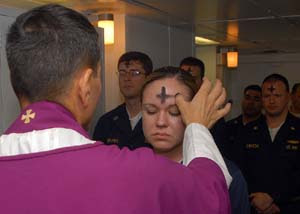
Tuesday, February 21, 2023

Why Do We Use Ashes on Ash Wednesday?


Why Do We Use Ashes on Ash Wednesday?


Ashes are placed on our foreheads on Ash Wednesday, in one of the most counter-cultural acts of our faith. It is done for two reasons: a personal act of remembrance and as a sign or a witness for others.


The ashes come from the burnt Palms from last year's Passion Sunday celebration, which begins Holy Week. So, these ashes bring us back to our last celebration of the Passion, Death and Resurrection of Jesus for us. On this first day of Lent, we begin a journey of renewal - from death to life. This is a joyful season. We will make sacrifices, in order to try to let God reform our desire, but this is a time for God to be generous to us.


When the ashes are placed on our foreheads, the minister says one of two formulas to help us remember who we are and the mission to which we are sent:


"Remember, man/woman, you are dust and to dust you will return."


"Turn away from sin and be faithful to the Gospel."


We are reminded that we are creatures and that our lives were given to us. But, we are also reminded that our lasting home is in eternity, with God. This is not our lasting home.


We are reminded that our call is to turn away from sin and to believe the Good News of our salvation in Jesus. This is a joyful reminder. It challenges us, for sure, but reminds us of why we want to turn from sin.


Finally, we wear our ashes as a sign. It is not a boastful sign through which I say, "Look at me and see how holy I am." No, it is much more like, "I'm willing to wear this sign in the world and say that I've been reminded of where I come from and where I am going. And, I've heard the call to turn away from a life of sin and to give my life to living the Gospel of Jesus." And, occasionally, in this world which is too often caught up in the denial of death, I might be required to answer the question, "What's with the smudge on your forehead?"


Yet even now, says the LORD, return to me with your whole heart, with fasting, and weeping, and mourning; Rend your hearts, not your garments, and return to the LORD, your God. For gracious and merciful is he, slow to anger, rich in kindness, and relenting in punishment. - Joel 2:12-13


A Brief on Ash Wednesday

Remember that you are dust, and to dust, you shall return. 


It was a common practice within the early Church that those who were found guilty of grave public sin needed to do public penance before they were admitted back into communion with the Church and admitted to the Most Holy Eucharist. The public sinners came forward in sackcloth forty days before Easter and were sprinkled with ashes, in keeping with many Old Testament examples of public penance. They fasted and prayed for forty days and then, on Easter, were readmitted into full communion with the Church. Eventually, prior to the end of the first millennium, this practice was extended to the entire Church as a way of highlighting everyone’s need for penance. One of the earliest mentions of this practice becoming universal comes from an English Benedictine monk who wrote: 


We read in the books both in the Old Law and in the New that the men who repented of their sins bestrewed themselves with ashes and clothed their bodies with sackcloth. Now let us do this little at the beginning of our Lent that we strew ashes upon our heads to signify that we ought to repent of our sins during the Lenten fast.


Today, as a sign of our ongoing need to repent of our sins and do penance, the faithful are invited to come forward to be marked with ashes as a sign of their commitment to the penitential season of Lent, so as to celebrate with great joy the Solemnity of Easter. Lent is forty-six days long. Forty of those days are penitential days, and six of them are Sundays. Lent begins on Ash Wednesday and concludes with the Easter Vigil. The forty penitential days are an imitation of Jesus’ forty days in the desert.


As we come forward to receive ashes, the minister traditionally says, “Remember that you are dust, and to dust you shall return.” This line is taken from the Book of Genesis when God expelled Adam and Eve from the Garden of Eden. He told Eve that she would suffer the pains of childbirth and be subjected to her husband. God told Adam that he would labor for his food through sweat and toil. To both of them, God said this curse would last “Until you return to the ground, from which you were taken; For you are dust, and to dust you shall return” (Genesis 3:19). Thus, the final curse of original sin is death: “…to dust you shall return.”


As we come forward to receive ashes, we should hear God saying to us, as He said to Adam and Eve, that we also suffer the consequences of original sin and will die. But that curse must be seen in the light of God’s final plan of salvation. Today, we acknowledge that the curse of death will endure but also hold onto the hope of resurrection made possible through Christ. Lent is a time of repentance for our sin and hope in redemption. Ash Wednesday is our liturgical and public statement that we have chosen both repentance and redemption.


As you come forward to receive the ashes today, don’t just go through the motions. Make this act a prayer and one of deep interior devotion. Call to mind your sins and the sins of your whole life, as best you can. Acknowledge the just punishment of eternal death that you deserve for your sins. But then call to mind the infinite and unmerited mercy of God. Remember that even though you are an undeserving sinner, God has reached down from Heaven to offer you the gift of eternal salvation. He has invited you to receive this gift through your repentance and humility. Humble yourself today in “sackcloth and ashes,” and as with those public sinners of old, God will use this Lent to more fully unite your soul with His through His glorious death and resurrection.


Prayer:

Most glorious and Triune God, You have justly condemned me but mercifully offered me redemption. As I enter this season of Lent, I wholeheartedly acknowledge my sin and repent. Please be merciful to me, a sinner. Help me to make this Lent a truly penitential season so that my soul will be more disposed to receive You this Easter. Jesus, I trust in You.


Thursday, January 27, 2022

What is a Synod


What is a Synod and its purpose?


A Synod is basically an ecclesiastic council, usually convened to decide an issue of doctrine, administration or application. The word synod comes from the Greek: σύνοδος [ˈsinoðos] meaning "assembly" or "meeting" and is analogous with the Latin word concilium meaning "council". 


When was the first council?


The Church has been having “councils” or meetings to figure things out since the time of the Apostles. The first church council was the meeting that Paul had with Peter, James, and the Apostles to deal with the issue of circumcision for Gentile converts. That was the Council of Jerusalem, and it happened around 48 AD (see Acts 15).

Since then, every time the Church encountered an issue that required clarification, a council was held.


Do we know of any well-known councils? 


The most well-known are Nicaea, Constantinople, Ephesus, Chalcedon, Lateran IV, Trent, and Vatican II. These were all called in order to respond to a crisis, heresy, or question, and as a result, doctrine was defined.

For example, the First Council of Nicaea in AD 325 gave us the Nicaean Creed. It also: defined the divine nature of God the Son and his relationship to God the Father; defined the universal observance of the date of Easter, and promulgated early canon law.

The Council of Rome in AD 382 defined the complete list of canonical books of both the Old and New Testaments.

The Council of Trent (1545–1563) was a response to the Reformation. It affirmed the role and canon of Scripture and defined the seven Sacraments.

In total, the Roman Catholic Church has held 21 councils. These were referred to as “ecumenical councils”. That means that the voting members come from the whole world (from the Greek oikoumene, referring to the “whole inhabited world”).

The last council was the 2nd Vatican Council (1962–1965) which was called by Pope John XXIII, not as a response to any specific issue that needed to be defined but as a desire for the Church to relate to the modern world.

According to some opinions, the 2nd Vatican Council was probably the last Church council because the Church now has synods. (After Vatican II, Pope Paul VI established the Synod of Bishops, an advisory board to the Holy Father. Since then, the bishops meet in assemblies (synods) and make recommendations to the pope. Since 1967, there have been 16 ordinary synods, 3 extraordinary synods, and 11 special synods).


Further brief on Ordinary, Extraordinary and Special Assemblies (Synods)


Ordinary Assemblies: These are synods that deal with universal topics that are pastoral in character and contemporary. Most synods that we can recall from recent years have been ordinary:

2001 "The Bishop: Servant of the Gospel of JESUS CHRIST for the hope of the world"

2005 "The Eucharist: Source and Summit of the Life and Mission of the Church"

2008 "The Word of God in the Life and Mission of the Church"

2012 "New Evangelisation for the Transmission of the Christian Faith"

2018 “Young People, the Faith and Vocational Discernment”


Extraordinary Assemblies: These deal with more urgent matters. For this reason these are shorter and with fewer participants. The most recent extraordinary synod was the 2014 one dealing with the "pastoral challenges of the family in the context of evangelization".


Special Assemblies: These deal with issues that are specific to a particular geographical area. There have been special synods for each continent of the world, Africa, America, Asia, Europe, Oceania, and the Middle East. The most recent one was on the Pan-Amazon Region in 2019.


Further:

The next Synod of Bishops is on the topic of synodality. This synodal process began in October 2021 and will conclude in October 2023 and will be hearing more on this topic in forthcoming days.


Pope Francis is a big fan of the synodal process. 


Synods work because that word, “synod”, doesn’t just mean meeting or assembly. It also means "walking together". A good image to keep in mind is Jesus walking together with the disciples on the road to Emmaus (Luke 24:13-35).


The most important thing that we have to remember about synods is that a synodal church is a listening church. A synod is a “walking with”, and that’s what we are called to do as Church.


At the end of the concluding address by Pope Francis from the 2015 Synod on the Family he said:


“To conclude the Synod means to return to our true 'journeying together' in bringing to every part of the world, to every diocese, to every community and every situation, the light of the Gospel, the embrace of the Church and the support of God’s mercy!”


Ultimately that is what we do as a Church: We meet people where they are in every place and in every situation. We walk with them, we listen to them, and then we try to do our best to bring to them the truth and the light of the Gospel, the good news! And then we continue to walk with them, through their joys and struggles, through their hopes and fears: We share with them Jesus himself, and then we let Jesus do the rest!


And so, a synod on synodality is really a synod about what it means to be Church.


(Synodality in the Catholic Church is a term "often used to describe the process of fraternal collaboration and discernment that bodies like the [Synod of Bishops] were created to express.")


  • Sourced from various sites


Monday, December 6, 2021

A Brief on The Holy Bible


 A brief on The Holy Bible:


1. What exactly is the Bible?

The Bible (also called the Scriptures or the Sacred Scriptures) is a collection of books that the church believes are the inspired words of God. God chose certain men to write these books under the direction of the Holy Spirit for the benefit of all mankind.


The Bible is like a library of books that were written over the course of a thousand years, from about 950 B.C to 100 A.D. It is the most important book that has ever been written in the history of mankind. (N.B: The earliest writing began when symbols were scratched or pressed on clay tablets. The Egyptians refined this technique and developed an early form of writing known as hieroglyphics. The Bible tells us that Moses was “educated in all the learning of the Egyptians”, so he would have been familiar with the major writing systems of his time. We also read that God gave Moses “two tablets of the Testimony, the tablets of stone inscribed by the finger of God”(Exodus 31:18). All this leads to the speculation that the earliest writings in the Bible were set down around 1400 BC).


However it is not important to remember when the Bible was written. The most important thing to know and believe is that The Bible is a sacred literature because it is the unique revelation of God, it is inspired by the Holy Spirit and it describes God’s plan for our salvation and eternal life. It centers entirely on Jesus Christ, who is God incarnate and the Savior of the world.


2. Why are there two parts of the Bible?

The Old Testament is a record of the old covenant between God and His chosen people. It describes mankind’s preparation for the coming of the Messiah.


The New Testament is a record of the new covenant made by God with the entire human race, through the life, death and resurrection of Jesus Christ, the son of God.


The Old Testament leads up to the time of Christ and the New Testament flows from the time of Christ.


The life of Jesus Christ separates the Old and New Testaments and is the center and focal point of the Bible.


In fact, time itself is centered and measured on the life and death of Jesus Christ and is the basis of our modern day calendar.


3. What is the Pentateuch?

The Pentateuch is the first five books of the Old Testament, namely:


Genesis

Exodus

Leviticus

Numbers

Deuteronomy


Many well known Bible stories are found in these books including the stories of Creation, Adam and Eve, Noah's Ark as well as other stories which tell of the origins of the Israelite people and their escape under the leadership of Moses from slavery in Egypt .


The Ten Commandments and other laws governing the life and worship of the Israelite people are also found in the Pentateuch. Hence, the other name for this section of the Old Testament is the Law or the Torah.


4. What are the Historical Books?

The Historical Books are exactly what you would expect them to be, a history of the Israelite people and of God's intervention in their history. They include:


Joshua

Judges

1 Samuel

2 Samuel

1 Kings

2 Kings

1 Chronicles

2 Chronicles

Ruth

Ezra

Nehemiah

Tobit

Judith

Esther

1 Maccabees

2 Maccabees


Stories of many well known men and women from Israelite history can be found in these books, including King David and King Solomon as well as Deborah, Judith and Queen Esther. The Historical Books reveal an interesting pattern in the relationship between God and his Chosen People. When the people are faithful to God and the law they are prosperous and God protects them from their enemies. When the people worship false gods and live immorally, in effect, saying to God, "We don't need you," disaster in one form or another overtakes them.


5. What are the Wisdom Books?

There are seven Wisdom books that are quite diverse in literary style and content. They include the Psalms, which are prayers written in poetic form. There are books about how to lead a successful life, like Proverbs and Sirach. The Song of Songs, one of the most sensual love poems ever written, gives us a sense of God's great love for his people. The Wisdom Books are:


Job

Psalms

Proverbs

Ecclesiastes

Song of Songs

Wisdom

Sirach


6. What are the Prophetic Books?

The Prophetic Books contain the writings of Israel's great prophets. The role of the prophets was to keep the Chosen People faithful to the covenant they had made with God and to call them back when they strayed. These powerful writings richly describe the rewards of faithfulness and the punishments of betrayal. Additionally and mysteriously, the prophetic books foretell the coming of the Messiah and give information about him. Jesus' birth in Bethlehem to a virgin, his ministry to the poor, the downtrodden and the sick, and his violent death are all foretold in the prophetic books. The Prophetic Books include:


Isaiah

Jeremiah

Ezekiel

Lamentations

Baruch

Daniel

Hosea

Joel

Amos

Obediah

Jonah

Micah

Nahum

Habakkuk

Zephaniah

Haggai

Zechariah

Malachi


7. What is the New Testament?

The New Testament is composed of twenty-seven books which were written in Greek between 50 A.D. and 140 A.D. It consists of the Gospels, the Acts of the Apostles, the Epistles or Letters and the Book of Revelation. The central theme of the New Testament, or Christian Scriptures, is Jesus Christ; his person, his message, his passion, death and resurrection, his identity as the promised Messiah and his relationship to us as Lord and brother.


8. Why was the New Testament written in Greek?

The New Testament was written in Greek because it was the most commonly spoken language of the Mediterranean world.


9. What are the Gospels?

The word gospel comes from the Old English word god-spel which means good news. There are four Gospels. Each Gospel is an account of the life, teachings, suffering, death and resurrection of Jesus Christ. The Gospels are:


Matthew

Mark

Luke

John


The gospels of Matthew, Mark, and Luke together are referred to as the synoptic gospels. "Synoptic" is derived from a Greek word meaning "one eye,' because these gospels look alike in structure and content. The Gospel of John, while not in conflict with the synoptic gospels, differs in structure and contains some stories and sayings of Jesus that are not found in them.


Many familiar Bible stories about Jesus can be found in the gospels, including the story of his birth in Bethlehem, the many stories about his healing of the sick, and parables like the story of the Prodigal Son.


10. What are the Acts of the Apostles?

The Acts of the Apostles was written by St. Luke about 70 A.D. to 75 A.D. It describes the faith, growth and way of life of early Christianity. The story of the Ascension of Jesus into heaven, the coming of the Holy Spirit to the church at Pentecost, the martyrdom of St. Stephen and the conversion of St. Paul can all be found in this book.


11. What are the Epistles?

The Epistles or Letters make up the largest part of the New Testament. They are usually divided into two categories: the Pauline Letters and other Apostolic Letters. All the letters follow the format of letter writing in the ancient world. Each letter usually begins with a greeting and an identification of the sender and the recipients. This is followed by a prayer, usually in the form of a thanksgiving. The body of the letter is an exposition of Christian teaching, usually responding to the circumstances of the recipients. It may be followed by a discussion of the author's future travel plans and conclude with practical advice and a farewell.


The Pauline Letters were written by St. Paul or one of his disciples; not long after the death and resurrection of Jesus, between 54 A.D. and 80 A.D. They indicate early developments of Christian theology and practice. Included in the Pauline Letters are:


Romans

1 & 2 Corinthians

Galatians

Ephesians

Philipppians

Colossians

1 & 2 Thessalonians

1 & 2 Timothy

Titus

Philemon


The Apostolic Letters are thought to be addressed, not so much to a particular community or individual, but to a more universal audience. They were written by various authors between 65 A.D. and 95 A.D. The Apostolic Letters are:


James

1 & 2 Peter

1, 2 & 3 John

Jude


12. What is the Book of Revelation?

The final book of the New Testament, the Book of Revelation, was written sometime after 90 A.D. In highly symbolic terms it presents the struggle between the church and the forces of evil and the eventual triumph of Jesus Although it contains some dreadful warnings about the future, it is essentially a message of hope to the church.


13. Who is the author of the Bible?

The author of the Bible is God. He revealed Himself throughout mankind’s history by communicating to human beings His merciful plan of salvation.


The Bible is a written record of God’s revelation of Himself through the messages and events that occurred throughout mankind’s history. God revealed who He is, through the words in the Bible, but also through the events that occurred in the lives of the people whose stories are recorded in the Bible.


We know who God is, through both His words and His actions.


14. Why do we think the Bible is the inspired word of God?

The Holy Spirit’s supernatural inspiration motivated the writers of sacred scripture to record the truth that was conveyed to them, in such a manner that could be interpreted correctly and understood by the people of their time and ours as well.


The Bible is like a love letter written by God for His people, through the promptings of the Holy Spirit.


15. Is the Bible free from errors?

The words of the Bible are always true in the sense intended by their human authors. The words that are recorded in the different books in the Bible may contain minor errors born from the culture in which the author lived, or their limited knowledge of the world (such as whether the earth was flat or round for an example).


Many of the stories in the Bible were passed down from generation to generation by word of mouth and were not written down until much later, but this too validates the importance of the words recorded in these books.


The Catholic church has studied these sacred texts for over 2,000 years and understands the historical time periods in which they were written, as well as the background and culture of the biblical writers themselves.


This is why we should rely more on the church’s interpretation of the sacred scriptures, than our own. However, the church does encourage us to read and reflect on the Bible for ourselves as well.


16. What are the Apocrypha Books?

Non-Catholics usually call the Deuterocanical Books of the Old Testament, the Apocrypha. These are the seven “extra” books that the Catholic Bible contains, but the Protestant Bible does not.


The reason the Catholic Bible has seven extra books is because when the Catholic church originally put together the 73 books of the Bible, these books were included as part of the canon.


However, when the Protestant reformation occurred, Martin Luther removed these books from the Catholic Bible because he did not believe they were divinely inspired. In recent times, however, many Protestant editions of the Bible now include these books and call them the Apocrypha.


The seven books that the Protestant Bibles do not include are:


Sirach, Wisdom, Judith, Tobit, Baruch, 1 Maccabees, 2 Maccabees. 

(Some also exclude: Longer version of Daniel & Longer version of Esther)


(Taken from various Catholic Sites)


Click on the topic for answers to Previous Five Queries


About Queen of the Holy Rosary

🌹 Queen of the Holy Rosary  Our Mother in Battle and in Blessing From the seas of Lepanto to the struggles of our hearts — the Rosary rema...