Thursday, September 21, 2023

Novena to Saint Thérèse of Lisieux – The Little Flower (Sept 22 to Sept 30)


Day One:

Come Holy Spirit and fill the hearts of the faithful, and kindle in them the fire of divine love.


V. Send forth Your Spirit and they shall be created.


R. And You shall renew the face of the earth.


Let us pray: O God, who have instructed the hearts of the faithful by the light of the Holy Spirit; grant that by the gift of the same Spirit, we may be ever truly wise and rejoice in His consolation, through Christ our Lord. Amen.


Acts of Faith, Hope, and Love: O my God! I believe in Thee: strengthen my faith. All my hopes are in Thee: do Thou secure them. I love Thee: teach me to love Thee daily more and more.


The Act of Contrition: O my God! I am heartily sorry for having offended You, and I detest all my sins, because I dread the loss of heaven and the pains of hell, but most of all because they offend You, my God, who are all good and deserving of all my love. I firmly resolve, with the help of Your grace, to confess my sins, to do penance , and to amend my life. Amen.


Day One Prayer: St. Thérèse, privileged Little Flower of Jesus and Mary, I approach you with childlike confidence and deep humility. I lay before you my desires, and beg that through your intercession they may be realized. Did you not promise to spend your Heaven doing good upon earth? Grant me according to this promise the favors I am asking from you.


(Offer your personal intentions…) Intercede for us all the days of our life, but specially during this Novena and obtain for us from God the graces and favors we ask through your intercession. Amen.


Thought for the day: Confidence in God. We can never have too much confidence in the good God who is so powerful and so merciful. We obtain from Him as much as we hope for.


If you are nothing, do you forget that Jesus is everything? You have only to lose your nothingness in His Infinity and think only of loving Him.


Concluding Prayer:


O Lord, You have said: Unless you become as little children you shall not enter the kingdom of heaven; grant us, we beg You, so to follow, in humility and simplicity of heart, the footsteps of the Virgin blessed Thérèse, that we may attain to an everlasting reward. Amen.


Day Two

Come Holy Spirit and fill the hearts of the faithful, and kindle in them the fire of divine love.


V. Send forth Your Spirit and they shall be created.


R. And You shall renew the face of the earth.


Let us pray: O God, who have instructed the hearts of the faithful by the light of the Holy Spirit; grant that by the gift of the same Spirit, we may be ever truly wise and rejoice in His consolation, through Christ our Lord. Amen.


Acts of Faith, Hope, and Love: O my God! I believe in Thee: strengthen my faith. All my hopes are in Thee: do Thou secure them. I love Thee: teach me to love Thee daily more and more.


The Act of Contrition: O my God! I am heartily sorry for having offended You, and I detest all my sins, because I dread the loss of heaven and the pains of hell, but most of all because they offend You, my God, who are all good and deserving of all my love. I firmly resolve, with the help of Your grace, to confess my sins, to do penance , and to amend my life. Amen.


Day Two Prayer: O dear little Saint, now that you see the Crucified Jesus in Heaven, still bearing the wounds caused by sin, you know still more clearly than you did upon earth the value of souls, and the priceless worth of that Precious Blood which He shed to save them. As I am one of those children for whom Christ died, obtain for me all the graces I need in order to profit by that Precious Blood. Use your great power with our Divine Lord and pray for me.


(Offer your personal intentions…) Intercede for us all the days of our life, but especially during this Novena and obtain for us from God the graces and favors we ask through your intercession. Amen.


Thought for the day: Sin. The only grace I ask, O Jesus, is never to offend Thee.


By love and not by fear, does a soul avoid committing the least fault.


Yes, even if I have on my conscience every possible crime, I should lose none of my confidence; my heart breaking with sorrow, I should go and throw myself into the arms of my Savior.


The remembrance of my faults humbles me and makes me afraid to rely on my own strength, which is nothing but weakness.


Concluding Prayer:


O Lord, You have said: Unless you become as little children you shall not enter the kingdom of heaven; grant us, we beg You, so to follow, in humility and simplicity of heart, the footsteps of the Virgin blessed Thérèse, that we may attain to an everlasting reward. Amen.


Day Three

Come Holy Spirit and fill the hearts of the faithful, and kindle in them the fire of divine love.


V. Send forth Your Spirit and they shall be created.


R. And You shall renew the face of the earth.


Let us pray: O God, who have instructed the hearts of the faithful by the light of the Holy Spirit; grant that by the gift of the same Spirit, we may be ever truly wise and rejoice in His consolation, through Christ our Lord. Amen.


Acts of Faith, Hope, and Love: O my God! I believe in Thee: strengthen my faith. All my hopes are in Thee: do Thou secure them. I love Thee: teach me to love Thee daily more and more.


The Act of Contrition: O my God! I am heartily sorry for having offended You, and I detest all my sins, because I dread the loss of heaven and the pains of hell, but most of all because they offend You, my God, who are all good and deserving of all my love. I firmly resolve, with the help of Your grace, to confess my sins, to do penance , and to amend my life. Amen.


Day Three Prayer: Dear Little Flower, make all things lead me to Heaven and God, Whether I look at the sun, the moon, the stars and the vast expanse in which they float, or whether I look at the flowers of the field, the trees of the forest, the beauties of the earth so full of color and so glorious, may they speak to me of the love and power of God; may they all sing His praises in my ear. Like you may I daily love Him more and more in return for His gifts. Teach me often to deny myself in my dealings with others, that I may offer to Jesus many little sacrifices.


(Offer your personal intentions…) Intercede for us all the days of our life, but especially during this Novena and obtain for us from God the graces and favors we ask through your intercession. Amen.


Thought for the day: The Use of God’s Gifts. How much benefit have I received from the beauties of nature, bestowed in such abundance. How they raise me to Him who placed such wonders in this land of exile which is only to last a day.


O sparkling nature, if I did not see God in you, you would be naught but a great tomb.


With your little hand which caresses Mary, You sustain the Universe and bestow life; and You think of me, O Jesus my little King.


I do not wish creatures to have one atom of my love. I wish to give all to Jesus, since He has shown me that He alone is perfect happiness.


Concluding Prayer:


O Lord, You have said: Unless you become as little children you shall not enter the kingdom of heaven; grant us, we beg You, so to follow, in humility and simplicity of heart, the footsteps of the Virgin blessed Thérèse, that we may attain to an everlasting reward. Amen.


Day Four

Come Holy Spirit and fill the hearts of the faithful, and kindle in them the fire of divine love.


V. Send forth Your Spirit and they shall be created.


R. And You shall renew the face of the earth.


Let us pray: O God, who have instructed the hearts of the faithful by the light of the Holy Spirit; grant that by the gift of the same Spirit, we may be ever truly wise and rejoice in His consolation, through Christ our Lord. Amen.


Acts of Faith, Hope, and Love: O my God! I believe in Thee: strengthen my faith. All my hopes are in Thee: do Thou secure them. I love Thee: teach me to love Thee daily more and more.


The Act of Contrition: O my God! I am heartily sorry for having offended You, and I detest all my sins, because I dread the loss of heaven and the pains of hell, but most of all because they offend You, my God, who are all good and deserving of all my love. I firmly resolve, with the help of Your grace, to confess my sins, to do penance , and to amend my life. Amen.


Day Four Prayer: Dear Little Flower of Carmel, bearing so patiently the disappointments and delays allowed by God, and preserving in the depths of your soul an unchanging peace because you sought only God’s will, ask for me complete conformity to that adorable Will in all the trials and disappointments of life. If the favors I am asking during this Novena are pleasing to God, obtain them for me. If not, it is true I shall feel the refusal keenly, but I too wish only God’s Will, and pray in the words you used, that I “may ever be perfectly fulfilled in me.”


(Offer your personal intentions…) Intercede for us all the days of our life, but especially during this Novena and obtain for us from God the graces and favors we ask through your intercession. Amen.


Thought for the day: Abandonment to God. I fear only one thing—to keep my own will; take it, my God, for I choose all that You choose.


The only happiness here below is to strive to be always content with what Jesus gives us.


I can demand nothing with fervor, except the perfect accomplishment of God’s will in my soul.


O my Beloved, I offer myself to You, that You may perfectly accomplish in me Your holy designs, and I will not allow anything created to be an obstacle in their path.


Concluding Prayer:


O Lord, You have said: Unless you become as little children you shall not enter the kingdom of heaven; grant us, we beg You, so to follow, in humility and simplicity of heart, the footsteps of the Virgin blessed Thérèse, that we may attain to an everlasting reward. Amen.


Day Five:

Come Holy Spirit and fill the hearts of the faithful, and kindle in them the fire of divine love.


V. Send forth Your Spirit and they shall be created.


R. And You shall renew the face of the earth.


Let us pray: O God, who have instructed the hearts of the faithful by the light of the Holy Spirit; grant that by the gift of the same Spirit, we may be ever truly wise and rejoice in His consolation, through Christ our Lord. Amen.


Acts of Faith, Hope, and Love: O my God! I believe in Thee: strengthen my faith. All my hopes are in Thee: do Thou secure them. I love Thee: teach me to love Thee daily more and more.


The Act of Contrition: O my God! I am heartily sorry for having offended You, and I detest all my sins, because I dread the loss of heaven and the pains of hell, but most of all because they offend You, my God, who are all good and deserving of all my love. I firmly resolve, with the help of Your grace, to confess my sins, to do penance , and to amend my life. Amen.


Day Five Prayer: Little Flower of Jesus, from the very first moment of your religious life you thought only of denying yourself in all things so as to follow Jesus more perfectly; help me to bear patiently the trials of my daily life. Teach me to make use of the trials, the sufferings, the humiliations, that come my way, to learn to know myself better and to love God more.


(Offer your personal intention…) Intercede for us all the days of our life, but especially during this Novena and obtain for us from God the graces and favors we ask through your intercession. Amen.


Thought for the day: Patience in Sufferings. I do not fear trials sent by Jesus, for even in the most bitter suffering we can see that it is His loving hand which causes it.


When we are expecting nothing but suffering, we are quite surprised at the least joy; but then suffering itself becomes the greatest of joys when we seek it as a precious treasure.


Far from resembling those beautiful saints who practiced all sorts of austerities from childhood, my penance consisted in breaking my self-will, in keeping back a sharp reply, in doing little kindnesses to those about me, but considering these deeds as nothing.


Concluding Prayer:


O Lord, You have said: Unless you become as little children you shall not enter the kingdom of heaven; grant us, we beg You, so to follow, in humility and simplicity of heart, the footsteps of the Virgin blessed Thérèse, that we may attain to an everlasting reward. Amen.


Day Six:

Come Holy Spirit and fill the hearts of the faithful, and kindle in them the fire of divine love.


V. Send forth Your Spirit and they shall be created.


R. And You shall renew the face of the earth.


Let us pray: O God, who have instructed the hearts of the faithful by the light of the Holy Spirit; grant that by the gift of the same Spirit, we may be ever truly wise and rejoice in His consolation, through Christ our Lord. Amen.


Acts of Faith, Hope, and Love: O my God! I believe in Thee: strengthen my faith. All my hopes are in Thee: do Thou secure them. I love Thee: teach me to love Thee daily more and more.


The Act of Contrition: O my God! I am heartily sorry for having offended You, and I detest all my sins, because I dread the loss of heaven and the pains of hell, but most of all because they offend You, my God, who are all good and deserving of all my love. I firmly resolve, with the help of Your grace, to confess my sins, to do penance , and to amend my life. Amen.


Day Six Prayer: St. Thérèse, Patroness of the Missions, be a great missionary throughout the world to the end of time. Remind our Master of His own words, “The harvest is great, but the laborers are few.” Your zeal for souls was so great, obtain a like zeal for those now working for souls, and beg God to multiply their numbers, that the millions to whom Jesus is yet unknown may be brought to know, love and follow Him.


(Offer your personal intentions…) Intercede for us all the days of our life, but especially during this Novena and obtain for us from God the graces and favors we ask through your intercession. Amen.


Thought for the day: Zeal for souls. Let us work together for the salvation of souls. We have only the day of this life to save souls and to give them to the Lord as proofs of our love.


I tell Jesus that I am glad not to be able to see, with the eyes of my soul, this beautiful Heaven which awaits me, in order that He may vouchsafe to open it forever to poor unbelievers.


I cannot perform brilliant works; I cannot preach the Gospel or shed my blood. But what matter? My brothers work in place of me, and I a little child, keep very close to the royal throne. I love for those who are carrying on the warfare.


My deeds, my little sufferings, can make God loved all over the world.


Concluding Prayer:


O Lord, You have said: Unless you become as little children you shall not enter the kingdom of heaven; grant us, we beg You, so to follow, in humility and simplicity of heart, the footsteps of the Virgin blessed Thérèse, that we may attain to an everlasting reward. Amen.


Day Seven:

Come Holy Spirit and fill the hearts of the faithful, and kindle in them the fire of divine love.


V. Send forth Your Spirit and they shall be created.


R. And You shall renew the face of the earth.


Let us pray: O God, who have instructed the hearts of the faithful by the light of the Holy Spirit; grant that by the gift of the same Spirit, we may be ever truly wise and rejoice in His consolation, through Christ our Lord. Amen.


Acts of Faith, Hope, and Love: O my God! I believe in Thee: strengthen my faith. All my hopes are in Thee: do Thou secure them. I love Thee: teach me to love Thee daily more and more.


The Act of Contrition: O my God! I am heartily sorry for having offended You, and I detest all my sins, because I dread the loss of heaven and the pains of hell, but most of all because they offend You, my God, who are all good and deserving of all my love. I firmly resolve, with the help of Your grace, to confess my sins, to do penance , and to amend my life. Amen.


Day Seven Prayer: O little martyr of Love, you know now even better than in the days of your pilgrimage that Love embraces all vocations; that it is Love alone which counts, which unites us perfectly to God and conforms our will with His. All you sought on earth was love; to love Jesus as He had never yet been loved. Use your power in Heaven to make us love Him. If only we love Him we shall desire to make Him loved by others; we shall pray much for souls. We shall no longer fear death, for it will unite us to Him forever. Obtain for us the grace to do all for the love of God, to give Him pleasure, to love Him so well that He may be pleased with us as He was with you.


(Offer your personal intentions…) Intercede for us all the days of our life, but especially during this Novena and obtain for us from God the graces and favors we ask through your intercession. Amen.


Thought for the day: Love of God. I will love God alone and will not have the misfortune of attaching myself to creatures, now that my heart perceive what He has in store for those who love Him.


What attracts me to the kingdom of Heaven is the call of our Lord, the hope of loving Him as I have so desired and the thought that I shall be able to make Him loved by a great number of souls who will bless Him forever.


When Christ said, “Give Me a Drink,” it was the love of His poor creatures that He, the Creator of all things, desired. He thirsted for love.


Remember that the dear Jesus is there in the tabernacle expressly for you, for you alone. Remember that He is consumed with a desire to come into your heart.


Concluding Prayer:


O Lord, You have said: Unless you become as little children you shall not enter the kingdom of heaven; grant us, we beg You, so to follow, in humility and simplicity of heart, the footsteps of the Virgin blessed Thérèse, that we may attain to an everlasting reward. Amen.


Day Eight

Come Holy Spirit and fill the hearts of the faithful, and kindle in them the fire of divine love.


V. Send forth Your Spirit and they shall be created.


R. And You shall renew the face of the earth.


Let us pray: O God, who have instructed the hearts of the faithful by the light of the Holy Spirit; grant that by the gift of the same Spirit, we may be ever truly wise and rejoice in His consolation, through Christ our Lord. Amen.


Acts of Faith, Hope, and Love: O my God! I believe in Thee: strengthen my faith. All my hopes are in Thee: do Thou secure them. I love Thee: teach me to love Thee daily more and more.


The Act of Contrition: O my God! I am heartily sorry for having offended You, and I detest all my sins, because I dread the loss of heaven and the pains of hell, but most of all because they offend You, my God, who are all good and deserving of all my love. I firmly resolve, with the help of Your grace, to confess my sins, to do penance , and to amend my life. Amen.


Day Eight Prayer: Dear St. Thérèse, like you I have to die one day. I beseech you, obtain from God, by reminding Him of your own precious death, that I may have a holy death, strengthened by the Sacraments of the Church, entirely resigned to the most holy Will of God, and burning with love for Him. May my last words on earth be, “My God. I love You.”


(Offer your personal intentions…) Intercede for us all the days of our life, but especially during this Novena and obtain for us from God the graces and favors we ask through your intercession. Amen.


Thought for the day: Death. It says in the catechism that death is nothing but the separation of the soul and body. Well, I have no fear of a separation which will unite me forever with the good God.


I am happy to die because I shall be able to help souls who are dear to me, far more than I can here below.


Life is not sad; it is very joyous. If you say, “This exile is sad,” I understand you. We are wrong to give the name “life” to something which will end; it is only to the things of Heaven that we should apply this beautiful name.


Concluding Prayer:


O Lord, You have said: Unless you become as little children you shall not enter the kingdom of heaven; grant us, we beg You, so to follow, in humility and simplicity of heart, the footsteps of the Virgin blessed Thérèse, that we may attain to an everlasting reward. Amen.


Day Nine

Come Holy Spirit and fill the hearts of the faithful, and kindle in them the fire of divine love.


V. Send forth Your Spirit and they shall be created.


R. And You shall renew the face of the earth.


Let us pray: O God, who have instructed the hearts of the faithful by the light of the Holy Spirit; grant that by the gift of the same Spirit, we may be ever truly wise and rejoice in His consolation, through Christ our Lord. Amen.


Acts of Faith, Hope, and Love: O my God! I believe in Thee: strengthen my faith. All my hopes are in Thee: do Thou secure them. I love Thee: teach me to love Thee daily more and more.


The Act of Contrition: O my God! I am heartily sorry for having offended You, and I detest all my sins, because I dread the loss of heaven and the pains of hell, but most of all because they offend You, my God, who are all good and deserving of all my love. I firmly resolve, with the help of Your grace, to confess my sins, to do penance , and to amend my life. Amen.


Day Nine Prayer: Dear Little St. Thérèse, by love and suffering while you were on earth, you won the power with God which you now enjoy in Heaven. Since your life there began, you have showered down countless blessings on this poor world; you have been an instrument made use of by your Divine Spouse to work countless miracles. I beg of you to remember all my wants. Sufferings must come to me also, may I use them to love God more, and follow my Jesus better. You are especially the little missionary of love. Make me love Jesus more, and all others for His sake. With all my heart I thank the Most Holy Trinity for the wonderful blessings conferred on you, and upon the world through you.


(Offer your personal intentions…) Intercede for us all the days of our life, but especially during this Novena and obtain for us from God the graces and favors we ask through your intercession. Amen.


Thought for the day: The Mission of the Little Flower. I do not intend to remain inactive in Heaven. I want to work for the Church and for souls. I have asked this of God and I am certain that He will grant my request.


I will spend my Heaven doing good upon earth. This is not impossible, since the angels though always enjoying the beatific vision, watch over us. No, I cannot be at rest until the end of the world.


I beseech Thee, O Jesus, to cast Thy divine glance on a great number of little souls. I beg of Thee to choose in this world a legion of little victims, worthy of Thy Love.


Concluding Prayer:


O Lord, You have said: Unless you become as little children you shall not enter the kingdom of heaven; grant us, we beg You, so to follow, in humility and simplicity of heart, the footsteps of the Virgin blessed Thérèse, that we may attain to an everlasting reward. Amen.


Thursday, April 6, 2023

INDULGENCES ATTACHED TO DIVINE MERCY DEVOTIONS

 INDULGENCES ATTACHED TO DIVINE MERCY DEVOTIONS

Apostolic Penitentiary


On 29 June, 2002, the Apostolic Penitentiary published the Decree in which the Holy Father attached a plenary and a partial indulgence to the devout observance of the Second Sunday of Easter or Divine Mercy Sunday. In an audience given to the Pro-Penitentiary Major and the Regent of the Apostolic Penitentiary on 13 June, 2002 the Holy Father approved the content of the Decree. The Decree was published in the press on 3 August 2002 and announced by the Holy Father at the Sunday Angelus on 4 August 2002.


DECREE


Indulgences attached to devotions in honour of Divine Mercy


"O God, your mercy knows no bounds and the treasure of your goodness is infinite..." (Prayer after the "Te Deum" Hymn) and "O God, you reveal your almighty power above all by showing mercy and forgiveness..." (Prayer for the 26th Sunday ofOrdinary Time), in these prayers Holy Mother Church humbly and faithfully sings of Divine Mercy. Indeed, God's great patience with the human race in general and with each individual person shines out in a special way when sins and moral failures are forgiven by Almighty God Himself and the guilty are readmitted in a fatherlike way to his friendship, which they deservedly lost.


Duty of honouring Divine Mercy


The faithful with deep spiritual affection are drawn to commemorate the mysteries of divine pardon and to celebrate them devoutly. They clearly understand the supreme benefit, indeed the duty, that the People of God have to praise Divine Mercy with special prayers and, at the same time, they realize that by gratefully performing the works required and satisfying the necessary conditions, they can obtain spiritual benefits that derive from the Treasury of the Church. "The paschal mystery is the culmination of this revealing and effecting of mercy, which is able to justify man, to restore justice in the sense of that salvific order which God willed from the beginning in man, and through man, in the world" (Encyclical Letter Dives in misericordia, n. 7).


It is God's Mercy that grants supernatural sorrow and resolution to amend


Indeed, Divine Mercy knows how to pardon even the most serious sins, and in doing so it moves the faithful to perceive a supernatural, not merely psychological, sorrow for their sins so that, ever with the help of divine grace, they may make a firm resolution not to sin any more. Such spiritual dispositions undeniably follow upon the forgiveness of mortal sin when the faithful fruitfully receive the sacrament of Penance or repent of their sin with an act of perfect charity and perfect contrition, with the resolution to receive the Sacrament of Penance as soon as they can. Indeed, Our Lord Jesus Christ teaches us in the parable of the Prodigal Son that the sinner must confess his misery to God saying: "Father I have sinned against heaven and against you; I am no longer worthy to be called your son" (Lk 15,18-19), realizing that this is a work of God, "for [he] was dead, and is alive; he was lost, and is found" (Lk 15,32).


Second Sunday of Easter, Divine Mercy Sunday


And so with provident pastoral sensitivity and in order to impress deeply on the souls of the faithful these precepts and teachings of the Christian faith, the Supreme Pontiff, John Paul II, moved by the consideration of the Father of Mercy, has willed that the Second Sunday of Easter be dedicated to recalling with special devotion these gifts of grace and gave this Sunday the name, "Divine Mercy Sunday" (Congregation for Divine Worship and the Discipline of the Sacraments, Decree Misericors et miserator, 5 May 2000).


The Gospel of the Second Sunday of Easter narrates the wonderful things Christ the Lord accomplished on the day of the Resurrection during his first public appearance: "On the evening of that day, the first day of the week, the doors being shut where the disciples were, for fear of the Jews, Jesus came and stood among them and said to them, 'Peace be with you'. When he said this, he showed them his hands and his side. Then the disciples were glad to see the Lord. Jesus said to them again, 'Peace be with you. As the Father has sent me, even so I send you'. And then he breathed on them, and said to them, 'Receive the Holy Spirit. If you forgive the sins of any, they are forgiven; if you retain the sins of any, they are retained" (Jn 20,19-23).


Plenary Indulgence


To ensure that the faithful would observe this day with intense devotion, the Supreme Pontiff himself established that this Sunday be enriched by a plenary indulgence, as will be explained below so that the faithful might receive in great abundance the gift of the consolation of the Holy Spirit. In this way, they can foster a growing love for God and for their neighbour, and after they have obtained God's pardon, they in turn might be persuaded to show a prompt pardon to their brothers and sisters.


Pardon of others who sin against us


Thus the faithful will more closely conform to the spirit of the Gospel, receiving in their hearts the renewal that the Second Vatican Council explained and introduced: "Mindful of the words of the Lord: 'By this, all men will know that you are my disciples if you have love for one another' (Jn 13,35), Christians can yearn for nothing more ardently than to serve the men of this age with an ever-growing generosity and success... It is the Father's will that we should recognize Christ our brother in the persons of all men and love them with an effective love, in word and in deed (Pastoral Constitution, Gaudium et spes, n. 93).


Three conditions for the plenary indulgence


And so the Supreme Pontiff, motivated by an ardent desire to foster in Christians this devotion to Divine Mercy as much as possible in the hope of offering great spiritual fruit to the faithful, in the Audience granted on 13 June 2002, to those Responsible for the Apostolic Penitentiary, granted the following Indulgences:


A plenary indulgence, granted under the usual conditions (sacramental confession, Eucharistic Communion and prayer for the intentions of Supreme Pontiff) to the faithful who, on the Second Sunday of Easter or Divine Mercy Sunday, in any church or chapel, in a spirit that is completely detached from the affection for a sin, even a venial sin, take part in the prayers and devotions held in honour of Divine Mercy, or who, in the presence of the Blessed Sacrament exposed or reserved in the tabernacle, recite the Our Father and the Creed, adding a devout prayer to the merciful Lord Jesus (e.g. Merciful Jesus, I trust in you!");


A partial indulgence, granted to the faithful who, at least with a contrite heart, pray to the merciful Lord Jesus a legitimately approved invocation.


For those who cannot go to church or the seriously ill


In addition, sailors working on the vast expanse of the sea; the countless brothers and sisters, whom the disasters of war, political events, local violence and other such causes have been driven out of their homeland; the sick and those who nurse them, and all who for a just cause cannot leave their homes or who carry out an activity for the community which cannot be postponed, may obtain a plenary indulgence on Divine Mercy Sunday, if totally detesting any sin, as has been said before, and with the intention of fulfilling as soon as possible the three usual conditions, will recite the Our Father and the Creed before a devout image of Our Merciful Lord Jesus and, in addition, pray a devout invocation to the Merciful Lord Jesus (e.g. Merciful Jesus, I trust in you).


If it is impossible that people do even this, on the same day they may obtain the Plenary Indulgence if, with a spiritual intention, they are united with those carrying out the prescribed practice for obtaining the Indulgence in the usual way and offer to the Merciful Lord a prayer and the sufferings of their illness and the difficulties of their lives, with the resolution to accomplish as soon as possible the three conditions prescribed to obtain the plenary indulgence.


Duty of priests: inform parishioners, hear confessions, lead prayers


Priests who exercise pastoral ministry, especially parish priests, should inform the faithful in the most suitable way of the Church's salutary provision. They should promptly and generously be willing to hear their confessions. On Divine Mercy Sunday, after celebrating Mass or Vespers, or during devotions in honour of Divine Mercy, with the dignity that is in accord with the rite, they should lead the recitation of the prayers that have been given above. Finally, since "Blessed are the merciful, for they shall obtain mercy" (Mt 5,7), when they instruct their people, priests should gently encourage the faithful to practise works of charity or mercy as often as they can, following the example of, and in obeying the commandment of Jesus Christ, as is listed for the second general concession of indulgence in the "Enchiridion Indulgentiarum".


This Decree has perpetual force, any provision to the contrary notwithstanding.


Archbishop Luigi De Magistris,

Tit.Archbishop of Nova

Major Pro-Penitentiary


Fr Gianfranco Girotti, O.F.M. Conv.,

Regent


Overview of the Devotion


There are usually four items associated with the devotion of Divine Mercy: the image, the feast, the Chaplet and the Hour of Mercy.


The Image


It takes its origin from a vision that St Faustina had in Płock on 22 February 1931. In that vision Christ expressed his desire to have such an image painted and that the words in the signature beneath it be: Jesus, I trust in you.


The image represents the Risen Christ, whose hands and feet bear the marks of the crucifixion. From his pierced Heart, not visible in the image, two rays issue forth: red and pale. Jesus explained their meaning. The red ray stands for the Blood which is the life of souls. The pale ray stands for the water that makes souls righteous. These two rays issued forth from the very depths of My tender mercy when My agonized Heart was opened by a lance on the Cross (299). The purpose of the image is to serve as an instrument for obtaining graces, and to be a sign reminding the world of the need to trust in God and to show mercy toward our neighbour. The words found in the signature speak of an attitude of trust. Jesus also said that the image is to be a reminder of the demands of My mercy because even the strongest faith is of no avail without works (742). The original image hangs in the convent of the Sisters of Our Lady of Mercy in Vilnius.


The Feast


According to Jesus' wish, the Feast of Mercy is to be celebrated on the first Sunday after Easter. Jesus is showing the close connection between the Easter mystery of man's redemption and this feast. The Feast Of Mercy is to be not only a day designated for the worship of God's mercy, but also a day of grace for all people, particularly for sinners. Jesus attached great promises to this feast. One is the promise of complete forgiveness of sins and punishment. In other words, this grace is equal to the one we receive in the sacrament of baptism. It offers a completely new beginning.


The Chaplet


Jesus dictated the Chaplet of divine mercy to St Faustina in Vilnius in 1935. In the revelations that followed He disclosed to her its value and efficacy, as well as the promises He attached to it.


In this prayer we are offering the Body and Blood, Soul and Divinity of Jesus Christ to God the Father. We are uniting ourselves with His sacrifice offered on the Cross for the salvation of the whole world. By offering the Father His most dearly beloved Son, we are using the most convincing argument with which we can pray. We are asking for mercy for us and for the whole world. The word "us" refers to the person praying the Chaplet and the "whole world" indicates all people living on earth and the souls in Purgatory. By praying the Chaplet we are performing an act of love toward our neighbour. The Chaplet is prayed on ordinary Rosary beads. It begins with the Our Father, Hail Mary and Apostles Creed on the first three beads of the Rosary. On the large bead before each decade: Eternal Father, I offer You the Body and Blood, Soul and Divinity of Your dearly beloved Son, our Lord Jesus Christ, in atonement for our sins and those of the whole world.On the 10 small beads of each decade: For the sake of His sorrowful Passion, have mercy on us and on the whole world. Conclude with (after five decades): Holy God, Holy Mighty One, Holy Immortal One, have mercy on us and on the whole world (3 times).


The Hour of Mercy


It is Jesus' desire that the moment of his death on the cross (3.00 P.M.) be venerated every day. It is the hour of grace for the whole world; mercy triumphed over justice. Suggested prayer at the hour of mercy: O Blood and Water, which gushed forth from the Heart of Jesus as a fount of Mercy for us, I trust in you.  


Taken from:

L'Osservatore Romano (the newspaper of the Holy See)

The Weekly Edition in English published on 21 August 2002,


Further Reading:

(Taken from an article by Robert Stackpole, STD, director of the John Paul II Institute of Divine Mercy, an apostolate of the Marian Fathers of the Immaculate Conception. He is the author of Divine Mercy: A Guide from Genesis to Benedict XVI) 


What is the difference between that special graces promised by Jesus for devout communicants on Divine Mercy Sunday, and the plenary indulgence for Divine Mercy Sunday devotions that was instituted several years ago by St. Pope John Paul II? Are they the same thing? Or are they different?


Simply put: They are NOT the same thing!


The main difference, of course, is that an "indulgence" is something offered to the faithful by the Church, as the keeper of the keys of the kingdom, with authority to "bind and loose" (see Mt 16:17-19). The special graces of Divine Mercy Sunday, on the other hand, were promised directly by our Lord, through a prophetic revelation given to St. Faustina (see Diary of Saint Maria Faustina Kowalska, 699). The Church has not officially ruled that this particular promise was an authentic supernatural revelation (and no Catholic is required to believe it as a matter of faith), but the Church has discerned, in various ways, that there is nothing that violates Catholic doctrine in this promise.


Briefly, here are the other main differences between the "special graces" promised by Jesus for Divine Mercy Sunday, and the plenary indulgence offered by the Church for special devotions to the Divine Mercy on Mercy Sunday:


1) To receive special graces that our Lord promised for Divine Mercy Sunday, the only condition is to receive Holy Communion worthily on Divine Mercy Sunday (or the Vigil celebration) by making a good Confession beforehand and staying in the state of grace and trusting in His Divine Mercy. Any plenary indulgence granted by the Church, on the other hand, involves the fulfilment of a number of conditions, including prayer for the Holy Father's intentions, Confession and Holy Eucharist, and the carrying out of the special indulgenced work (in this case: participating in public devotions to the Divine Mercy on Divine Mercy Sunday itself).


2) The special graces promised by our Lord for Divine Mercy Sunday can be received by a soul in a state of grace, but with imperfect love for God, and imperfect contrition for sin-as long as the soul merely trusts in the mercy of God, and clings to Him because of His promised benefits. A plenary indulgence, however, can only be obtained through the performance of an indulgenced work as an expression of pure love for God. If the intentions of one's indulgenced work are not pure (say, the work is done in part out of fear of hell or purgatory, and loathing for oneself - or the desire to impress one's friends and relatives! - rather than purely out of love for God) then the indulgence obtained will be only partial, not plenary.


3) The special graces that our Lord promised for Mercy Sunday can only be received for oneself, through the devout reception of Holy Communion on Mercy Sunday (as stated in #1 above). A plenary indulgence, however, can be offered for oneself, or for souls suffering in purgatory.


4) The most special grace promised by our Lord for Mercy Sunday is nothing less than the equivalent of a complete renewal of baptismal grace in the soul: "complete forgiveness (remission) of sins and punishment." Such a measure of grace can only be received otherwise through baptism itself, or through making a sacramental confession as an act of perfect contrition for sin, out of pure love for God.


For a more in-depth study of this same subject you may visit the website of John Paul II Institute of Divine Mercy at ‘thedivinenercy.org’ and browse through their document entitled "Understanding Divine Mercy Sunday."


Tuesday, February 21, 2023

Why Do We Use Ashes on Ash Wednesday?


Why Do We Use Ashes on Ash Wednesday?


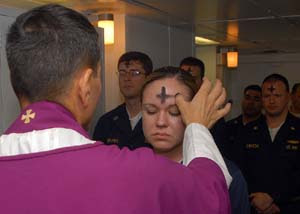
Ashes are placed on our foreheads on Ash Wednesday, in one of the most counter-cultural acts of our faith. It is done for two reasons: a personal act of remembrance and as a sign or a witness for others.


The ashes come from the burnt Palms from last year's Passion Sunday celebration, which begins Holy Week. So, these ashes bring us back to our last celebration of the Passion, Death and Resurrection of Jesus for us. On this first day of Lent, we begin a journey of renewal - from death to life. This is a joyful season. We will make sacrifices, in order to try to let God reform our desire, but this is a time for God to be generous to us.


When the ashes are placed on our foreheads, the minister says one of two formulas to help us remember who we are and the mission to which we are sent:


"Remember, man/woman, you are dust and to dust you will return."


"Turn away from sin and be faithful to the Gospel."


We are reminded that we are creatures and that our lives were given to us. But, we are also reminded that our lasting home is in eternity, with God. This is not our lasting home.


We are reminded that our call is to turn away from sin and to believe the Good News of our salvation in Jesus. This is a joyful reminder. It challenges us, for sure, but reminds us of why we want to turn from sin.


Finally, we wear our ashes as a sign. It is not a boastful sign through which I say, "Look at me and see how holy I am." No, it is much more like, "I'm willing to wear this sign in the world and say that I've been reminded of where I come from and where I am going. And, I've heard the call to turn away from a life of sin and to give my life to living the Gospel of Jesus." And, occasionally, in this world which is too often caught up in the denial of death, I might be required to answer the question, "What's with the smudge on your forehead?"


Yet even now, says the LORD, return to me with your whole heart, with fasting, and weeping, and mourning; Rend your hearts, not your garments, and return to the LORD, your God. For gracious and merciful is he, slow to anger, rich in kindness, and relenting in punishment. - Joel 2:12-13


A Brief on Ash Wednesday

Remember that you are dust, and to dust, you shall return. 


It was a common practice within the early Church that those who were found guilty of grave public sin needed to do public penance before they were admitted back into communion with the Church and admitted to the Most Holy Eucharist. The public sinners came forward in sackcloth forty days before Easter and were sprinkled with ashes, in keeping with many Old Testament examples of public penance. They fasted and prayed for forty days and then, on Easter, were readmitted into full communion with the Church. Eventually, prior to the end of the first millennium, this practice was extended to the entire Church as a way of highlighting everyone’s need for penance. One of the earliest mentions of this practice becoming universal comes from an English Benedictine monk who wrote: 


We read in the books both in the Old Law and in the New that the men who repented of their sins bestrewed themselves with ashes and clothed their bodies with sackcloth. Now let us do this little at the beginning of our Lent that we strew ashes upon our heads to signify that we ought to repent of our sins during the Lenten fast.


Today, as a sign of our ongoing need to repent of our sins and do penance, the faithful are invited to come forward to be marked with ashes as a sign of their commitment to the penitential season of Lent, so as to celebrate with great joy the Solemnity of Easter. Lent is forty-six days long. Forty of those days are penitential days, and six of them are Sundays. Lent begins on Ash Wednesday and concludes with the Easter Vigil. The forty penitential days are an imitation of Jesus’ forty days in the desert.


As we come forward to receive ashes, the minister traditionally says, “Remember that you are dust, and to dust you shall return.” This line is taken from the Book of Genesis when God expelled Adam and Eve from the Garden of Eden. He told Eve that she would suffer the pains of childbirth and be subjected to her husband. God told Adam that he would labor for his food through sweat and toil. To both of them, God said this curse would last “Until you return to the ground, from which you were taken; For you are dust, and to dust you shall return” (Genesis 3:19). Thus, the final curse of original sin is death: “…to dust you shall return.”


As we come forward to receive ashes, we should hear God saying to us, as He said to Adam and Eve, that we also suffer the consequences of original sin and will die. But that curse must be seen in the light of God’s final plan of salvation. Today, we acknowledge that the curse of death will endure but also hold onto the hope of resurrection made possible through Christ. Lent is a time of repentance for our sin and hope in redemption. Ash Wednesday is our liturgical and public statement that we have chosen both repentance and redemption.


As you come forward to receive the ashes today, don’t just go through the motions. Make this act a prayer and one of deep interior devotion. Call to mind your sins and the sins of your whole life, as best you can. Acknowledge the just punishment of eternal death that you deserve for your sins. But then call to mind the infinite and unmerited mercy of God. Remember that even though you are an undeserving sinner, God has reached down from Heaven to offer you the gift of eternal salvation. He has invited you to receive this gift through your repentance and humility. Humble yourself today in “sackcloth and ashes,” and as with those public sinners of old, God will use this Lent to more fully unite your soul with His through His glorious death and resurrection.


Prayer:

Most glorious and Triune God, You have justly condemned me but mercifully offered me redemption. As I enter this season of Lent, I wholeheartedly acknowledge my sin and repent. Please be merciful to me, a sinner. Help me to make this Lent a truly penitential season so that my soul will be more disposed to receive You this Easter. Jesus, I trust in You.


Monday, January 16, 2023

Do Catholics Worship Statues?


Do Catholics Worship Statues?

“Catholics worship statues!” People still make this ridiculous claim. Because Catholics have statues in their churches, goes the accusation, they are violating God’s commandment: “You shall not make for yourself a graven image or any likeness of anything that is in heaven above, or that is in the earth beneath, or that is in the water under the earth: you shall not bow down to them or serve them” (Ex. 20:4–5).

It is right to warn people against the sin of idolatry when they are committing it. But calling Catholics idolaters because they have images of Christ and the saints is based on misunderstanding or ignorance of what the Bible says about the purpose and uses (both good and bad) of statues.

Anti-Catholic writer Loraine Boettner, in his book Roman Catholicism, makes the blanket statement, “God has forbidden the use of images in worship” (281). Yet if people were to “search the scriptures” (John 5:39), they would find the opposite is true. God forbade the worship of statues, but he did not forbid the religious use of statues. Instead, he actually commanded their use in religious contexts!

God Said to Make Them
People who oppose religious statuary forget about the many passages where the Lord commands the making of statues. For example: “And you shall make two cherubim of gold [i.e., two gold statues of angels]; of hammered work shall you make them, on the two ends of the mercy seat. Make one cherub on the one end, and one cherub on the other end; of one piece of the mercy seat shall you make the cherubim on its two ends. The cherubim shall spread out their wings above, overshadowing the mercy seat with their wings, their faces one to another; toward the mercy seat shall the faces of the cherubim be” (Ex. 25:18–20).

David gave Solomon the plan “for the altar of incense made of refined gold, and its weight; also his plan for the golden chariot of the cherubim that spread their wings and covered the ark of the covenant of the Lord. All this he made clear by the writing of the hand of the Lord concerning it all” (1 Chr. 28:18–19). David’s plan for the temple included statues of angels.

Similarly Ezekiel 41:17–18 describes graven (carved) images in the idealized temple he was shown in a vision, for he writes, “On the walls round about in the inner room and [on] the nave were carved likenesses of cherubim.”

The Religious Uses of Images
During a plague of serpents sent to punish the Israelites during the exodus, God told Moses to “make [a statue of] a fiery serpent, and set it on a pole; and every one who is bitten, when he sees it shall live. So Moses made a bronze serpent, and set it on a pole; and if a serpent bit any man, he would look at the bronze serpent and live” (Num. 21:8–9).

One had to look at the bronze statue of the serpent to be healed, which shows that statues could be used ritually, not merely as religious decorations.

Catholics use statues, paintings, and other artistic devices to recall the person or thing depicted. Just as it helps to remember one’s mother by looking at her photograph, so it helps to recall the example of the saints by looking at pictures of them. Catholics also use statues as teaching tools. In the early Church they were especially useful for the instruction of the illiterate. Many Protestants have pictures of Jesus and other Bible pictures in Sunday school for teaching children. Catholics also use statues to commemorate certain people and events, much as Protestant churches have three-dimensional nativity scenes at Christmas.

If one measured Protestants by the same rule, then by using these “graven” images, they would be practicing the “idolatry” of which they accuse Catholics. But there’s no idolatry going on in these situations. God forbids the worship of images as gods, but he doesn’t ban the making of images.

It is when people begin to adore a statue as a god that the Lord becomes angry. Thus, when people did start to worship the bronze serpent as a snake-god (whom they named “Nehushtan”), the righteous king Hezekiah had it destroyed (2 Kgs. 18:4).

What About Bowing?
Sometimes anti-Catholics cite Deuteronomy 5:9, where God said concerning idols, “You shall not bow down to them.” Since many Catholics sometimes bow or kneel in front of statues of Jesus and the saints, anti-Catholics confuse the legitimate veneration of a sacred image with the sin of idolatry.

Though bowing can be used as a posture in worship, not all bowing is worship. In Japan, people show respect by bowing in greeting (the equivalent of the Western handshake). Similarly, a person can kneel before a king without worshipping him as a god. In the same way, a Catholic who may kneel in front of a statue while praying isn’t worshipping the statue or even praying to it, any more than the Protestant who kneels with a Bible in his hands when praying is worshipping the Bible or praying to it.

Hiding the Second Commandment?
Another charge sometimes made by Protestants is that the Catholic Church “hides” the second commandment. This is because in Catholic catechisms, the first commandment is often listed as “You shall have no other gods before me” (Ex. 20:3), and the second is listed as “You shall not take the name of the Lord in vain.” (Ex. 20:7). From this, it is argued that Catholics have deleted the prohibition of idolatry to justify their use of religious statues. But this is false. Catholics simply group the commandments differently from most Protestants.

In Exodus 20:2–17, which gives the Ten Commandments, there are actually fourteen imperative statements. To arrive at Ten Commandments, some statements have to be grouped together, and there is more than one way of doing this. Since, in the ancient world, polytheism and idolatry were always united—idolatry being the outward expression of polytheism—the historic Jewish numbering of the Ten Commandments has always grouped together the imperatives “You shall have no other gods before me” (Ex. 20:3) and “You shall not make for yourself a graven image” (Ex. 20:4). The historic Catholic numbering follows the Jewish numbering on this point, as does the historic Lutheran numbering.

Jews and Christians abbreviate the commandments so that they can be remembered using a summary, ten-point formula. For example, Jews, Catholics, and Protestants typically summarize the Sabbath commandment as, “Remember the Sabbath to keep it holy,” though the commandment’s actual text takes four verses (Ex. 20:8–11).

When the prohibition of polytheism/idolatry is summarized, Jews, Catholics, and Lutherans abbreviate it as “You shall have no other gods before me.” This is no attempt to “hide” the idolatry prohibition (Jews and Lutherans don’t even use statues of saints and angels). It is to make learning the Ten Commandments easier.

The Catholic Church is not dogmatic about how the Ten Commandments are to be numbered, however. The Catechism of the Catholic Church says, “The division and numbering of the Commandments have varied in the course of history. The present catechism follows the division of the Commandments established by Augustine, which has become traditional in the Catholic Church. It is also that of the Lutheran confession. The Greek Fathers worked out a slightly different division, which is found in the Orthodox Churches and Reformed communities” (CCC 2066).

The Form of God?
Some anti-Catholics appeal to Deuteronomy 4:15–18 in their attack on religious statues: “[S]ince you saw no form on the day that the Lord spoke to you at Horeb out of the midst of the fire, beware lest you act corruptly by making a graven image for yourselves, in the form of any figure, the likeness of male or female, the likeness of any beast that is on the earth, the likeness of any winged bird that flies in the air, the likeness of anything that creeps on the ground, the likeness of any fish that is in the water under the earth.”

We’ve already shown that God doesn’t prohibit the making of statues or images of various creatures for religious purposes (cf. 1 Kgs. 6:29–32, 8:6–66; 2 Chr. 3:7–14). But what about statues or images that represent God? Many Protestants would say that’s wrong because Deuteronomy 4 says the Israelites did not see God under any form when he made the covenant with them; therefore we should not make symbolic representations of God either. But does Deuteronomy 4 forbid such representations?

The Answer Is No
Early in its history, Israel was forbidden to make any depictions of God because he had not revealed himself in a visible form. Given the pagan culture surrounding them, the Israelites might have been tempted to worship God in the form of an animal or some natural object (e.g., a bull or the sun).

But later God did reveal himself under visible forms, such as in Daniel 7:9: “As I looked, thrones were placed and one that was Ancient of Days took his seat; his raiment was white as snow, and the hair of his head like pure wool; his throne was fiery flames, its wheels were burning fire.” Protestants make depictions of the Father under this form when they do illustrations of Old Testament prophecies.

The Holy Spirit revealed himself under at least two visible forms—that of a dove, at the baptism of Jesus (Matt. 3:16; Mark 1:10; Luke 3:22; John 1:32), and as tongues of fire, on the day of Pentecost (Acts 2:1–4). Protestants use these images when drawing or painting these biblical episodes and when they wear Holy Spirit lapel pins or place dove emblems on their cars.

But more important, in the incarnation of Christ his Son, God showed mankind an icon of himself. Paul said, “He is the image (Greek: ikon) of the invisible God, the firstborn of all creation.” Christ is the tangible, divine “icon” of the unseen, infinite God.

We read that when the magi were “going into the house they saw the child with Mary his mother, and they fell down and worshipped him. Then, opening their treasures, they offered him gifts, gold, frankincense, and myrrh” (Matt. 2:11). Though God did not reveal a form for himself on Mount Horeb, he did reveal one in the house in Bethlehem.

Common sense tells us that, since God has revealed himself in various images, most especially in the incarnate Jesus Christ, it’s not wrong for us to use images of these forms to deepen our knowledge and love of God. That’s why God revealed himself in these visible forms, and that’s why statues and pictures are made of them.

Idolatry Condemned by the Church
Since the days of the apostles, the Catholic Church has consistently condemned the sin of idolatry. The Catechism of the Council of Trent (1566) taught that idolatry is committed “by worshipping idols and images as God, or believing that they possess any divinity or virtue entitling them to our worship, by praying to, or reposing confidence in them” (374).

What anti-Catholics fail to recognize is the distinction between thinking a piece of stone or plaster is a god and desiring to visually remember Christ and the saints in heaven by making statues in their honor. The making and use of religious statues is a thoroughly biblical practice. Anyone who says otherwise doesn’t know his Bible.

---------------------------------------------------------------------------------------------------------------
NIHIL OBSTAT: I have concluded that the materials presented in this work are free of doctrinal or moral errors.
Bernadeane Carr, STL, Censor Librorum, August 10, 2004

IMPRIMATUR: In accord with 1983 CIC 827 permission to publish this work is hereby granted.
+Robert H. Brom, Bishop of San Diego, August 10, 2004


Friday, September 30, 2022

St. Thérèse of Lisieux - (St. Thérèse of The Child Jesus)


St. Thérèse of Lisieux


St. Thérèse of Lisieux, Religious

1873 – 1897

October 1 – Memorial

Liturgical Color: White

Patron Saint of florists, missions & aviators


A sensitive country girl confines herself to a convent and writes about spiritual truths


Thérèse Martin was a weepy child, as emotionally brittle as porcelain. She was easily offended and easily pleased. A furled brow or a sideways glance from her father would dissolve her into tears. A beautiful flower or a kind word and she would beam a smile. She grew up in a brotherless home. Her father, an uncle, and priests were the men in her life. Her parents were canonized in 2015, the only married couple ever raised to the altars. Thérèse and her four sisters all became nuns, with the cause for beatification and canonization of her sister Léonie being opened in 2015. The Martin home was totally absorbed in the mysteries of God, prayer, saints, the Sacraments, and the Church. 


Thérèse grew up in Normandy, a region of Northern France. She left only once, to go on a month-long pilgrimage to Italy, where she met Pope Leo XIII at a public audience and begged his special permission to enter the Carmelites before the required age. On this trip she was also the object of some tender male glances. Conscious of her delicate emotions and eager to flee the world’s “poisonous breath,” upon returning from Italy Thérèse pulled every lever to enter her local Carmel. She finally entered at the age of fifteen in 1888. She was given the religious name “of the Child Jesus” and received permission to adopt a second name too, “of the Holy Face.” Once the door of the convent shut behind her, it never reopened. Her short life ended there just nine years later. Thérèse was a dedicated nun who strictly followed the demanding Carmelite rule. She kept silence when required, avoided seeking out her blood sisters, fasted, ingratiated herself with nuns she did not naturally find sympathetic, and spent long hours in prayer and work. 


In the convent, Thérèse’s childish sweetness matured into a more durable spirituality. Her sensitivity mellowed. She was able to accept criticism. Her youthful presumption that all priests were as perfect as diamonds became more realistic, and she prayed and sacrificed ardently for priests. The hard realities of convent life narrowed Thérèse’s spiritual goals. She no longer desired to be a great soul like Saint Joan of Arc. But with this narrowing came a deepening, a concentrated focus. She decided she would be God’s heart, not His hands or feet or mind. She decided that the only way she could fly close to the blazing sun of the Holy Trinity would be to become small. Her petite voie (“little way” or “by small means”) was to spiritually reduce herself to a tiny creature carried in the claws of the divine eagle, Jesus Christ. As Christ soared in the heavens, she would be in His grasp, going only where He could go, until she was burned up in the Father-Son-Spirit love of the fireball of the Trinity. This was no broad path or wide way, but a little way for a great soul. The goal was to reduce oneself to nothing so the Lord could transport you. The goal was to remove the “self” from “oneself.” 


When Thérèse’s sister Céline entered the convent in 1894, she was given permission to bring her camera. Céline’s pictures of Thérèse would be among the first ever taken of a saint. They complimented Thérèse’s letters and spiritual writings perfectly, heightening interest in Thérèse after she died. The intriguing photos and profound writings hinted at the secret depths concealed behind a convent’s four walls. Saint Thérèse suffered intensely from tuberculosis and died at an age when many lives are just beginning to flower. She was canonized in 1925, declared co-patron of France in 1944, and named the thirty-third Doctor of the Church by Pope Saint John Paul II in 1997, the youngest Doctor to date and probably the youngest the Church will ever recognize.


Saint Thérèse of the Child Jesus and of the Holy Face, you discovered deep truths in a confined space. Your soul was fertile ground for the mysteries of our faith. Lend heavenly assistance to all who try to emulate your example of suffering, prayer, and tender dedication to God.


Monday, August 8, 2022

Catholics and Christians

Q. Since I started college this fall, I’ve been making a lot of friends who aren’t Catholic. Some of them are Christian, but some of them don’t even go to church. When we talk, I’m not really sure how to tell them what’s the big deal about being Catholic. What should I say?

A. I’d say you have a great opportunity to make a difference in their lives! Our Catholic faith is something that is an incredible gift. Therefore, to understand it, live it and spread it is an incredible privilege. So when your new friends ask about your faith I’d say you have a great opportunity to give them something they will greatly benefit from.

Sharing the Catholic faith with your friends is something that, perhaps, can only be done by you. Maybe at some later time in their lives they will encounter another good Catholic who will share his/her faith with them but, then again, maybe not. So I’d encourage you to look at this opportunity as possibly their “once in a lifetime” opportunity to learn about the incredible gift of the Catholic faith.

As Catholics we believe that we are privileged to have the fullness of the faith. What does this mean? It especially means two things. First, it means that we are blessed to have the fullest understanding of what Jesus wants us to understand and believe. As Catholics we trace our faith roots all the way back to Jesus Himself. All Popes are successors to St. Peter and, thus, shares in the divine mandate to hold the keys to the Kingdom of Heaven! That means they continue to guide us into all truth and teach us with the authority of Jesus Himself. This understanding is one that everyone needs to understand.

Furthermore, we, as Catholics, are blessed beyond what we can ever imagine by being able to share in the sacramental life of the Church. Though sometimes the Sacraments may seem dry, dull and repetitious to some, to those who understand the Sacraments they are the greatest way of connecting to God and receiving His grace.

These facts about the Catholic faith may be hard to explain but let me offer a suggestion on how to do just that.

First, I suggest that you keep striving to understand and live your own Catholic faith to the fullest. Study the faith, celebrate the Sacraments with great devotion, and try to discover the great gift that this faith gives you.

Second, when you are living fully as a Catholic, the best way to share that faith is to speak to your friends on a personal level. In other words, if you regularly live the Catholic faith then, when the opportunity presents itself, you can easily tell your friends how much this faith means to you. You can share how God comes to meet you as you attend Mass and Reconciliation. You can explain your deep confidence in Jesus’ teaching as it comes to you from the pope and bishops. And you can simply share your deep love for God as you meet Him daily in the Catholic Church.

Sharing this with your friends may have the effect of igniting within them a desire to gain what you have. When they see your joy, your faith and you devotion they may simply want to jump on board and discover what the Catholic Church is all about.

The bottom line is that if you truly love being a Catholic and live it to the fullest you will automatically draw others to what you have discovered. God will guide you in this if you are open to let Him use you. And remember, you may be the only opportunity that these new friends have to discover God within our glorious Catholic Church!

(Taken from Catholic Q & A)

Click on the title below for answers to previous five queries


About Queen of the Holy Rosary

🌹 Queen of the Holy Rosary  Our Mother in Battle and in Blessing From the seas of Lepanto to the struggles of our hearts — the Rosary rema...